

The real estate problem isn’t “lack of data” — it’s lack of context
Real estate is not a single workflow. It’s an economic system that stretches from land acquisition and design to approvals, construction, procurement, sales/leasing, collections, facilities, and investor reporting. Most organisations run this system with a patchwork of spreadsheets, email threads, point tools, and ERP fragments.
That fragmentation doesn’t just slow teams down — it breaks context. People make capital decisions with partial visibility, stale numbers, and inconsistent definitions (“What counts as committed CAPEX?” “Which milestone triggers billing?” “Is this variation approved or only requested?”). When context is missing, execution becomes reactive, and the cost of reaction shows up as overruns, rework, delayed sales conversion, and unpredictable cash.
Context Engineering starts from a simple premise: outcomes improve when decisions are made with the right information in the right shape at the right time. In real estate, that “shape” is a connected operating model that mirrors how value is actually created on the ground.
Custom software doesn’t predict markets — it improves investor-grade execution
It’s important to separate two ideas:
- Equity markets respond to interest rates, liquidity, policy, earnings, and sentiment.
- Real estate operations respond to visibility, discipline, throughput, and control.
Custom software cannot guarantee a bullish market. But it can create the operational conditions investors consistently reward: predictable delivery, controlled CAPEX, reliable cash conversion, and auditable reporting.
In other words, software doesn’t manufacture optimism; it manufactures credibility.
From “tools” to an operating system: what changes when workflows become products
A spreadsheet is a record. A disconnected app is a local optimisation. An operating system is a set of connected capabilities that enforce shared truth.
When real estate functions run through a purpose-built product, three structural shifts happen:
- The organisation moves from reporting to steering Instead of assembling status after the fact, teams see leading indicators while there’s still time to intervene.
- Capital allocation becomes a controlled loop CAPEX decisions stop being one-off approvals and become a measurable cycle: plan → commit → execute → verify → learn.
- Execution becomes legible across the portfolio A site manager, finance lead, procurement officer, and investor relations team can operate on the same definitions, not translations.
This is where “economic momentum” becomes real: not as hype, but as compounding operational advantage.
The financial mechanics: where the value actually lands
The impact of software-enabled operations is practical and measurable.
Balance sheet: working capital becomes a managed asset
When receivables, payables, retention, and milestone billing are connected to real execution, working capital stops being a surprise and becomes a lever.
- Better receivables control reduces days sales outstanding (DSO)
- Clean milestone definitions reduce disputes and write-offs
- Portfolio-level cash visibility improves financing decisions
Income statement: fewer leaks, less rework, better utilisation
Disconnected processes create hidden costs:
- Rework from outdated drawings/specs
- Procurement leakage from non-compliant purchasing
- Cost overruns from late variation approvals
A custom product can enforce approvals, track variations, and connect procurement to budgets and contracts — reducing leakage and improving margin quality.
Cash flow: faster conversion and higher-quality cash
Cash flow improves when execution and finance are coupled:
- Milestones trigger billing automatically when conditions are met
- Collections are prioritised based on risk and contract terms
- Forecasts are driven by real progress, not optimistic updates
This doesn’t just improve cash quantity; it improves cash quality — predictable, auditable, and usable for future CAPEX.
Context Engineering applied: designing software around “decision moments”
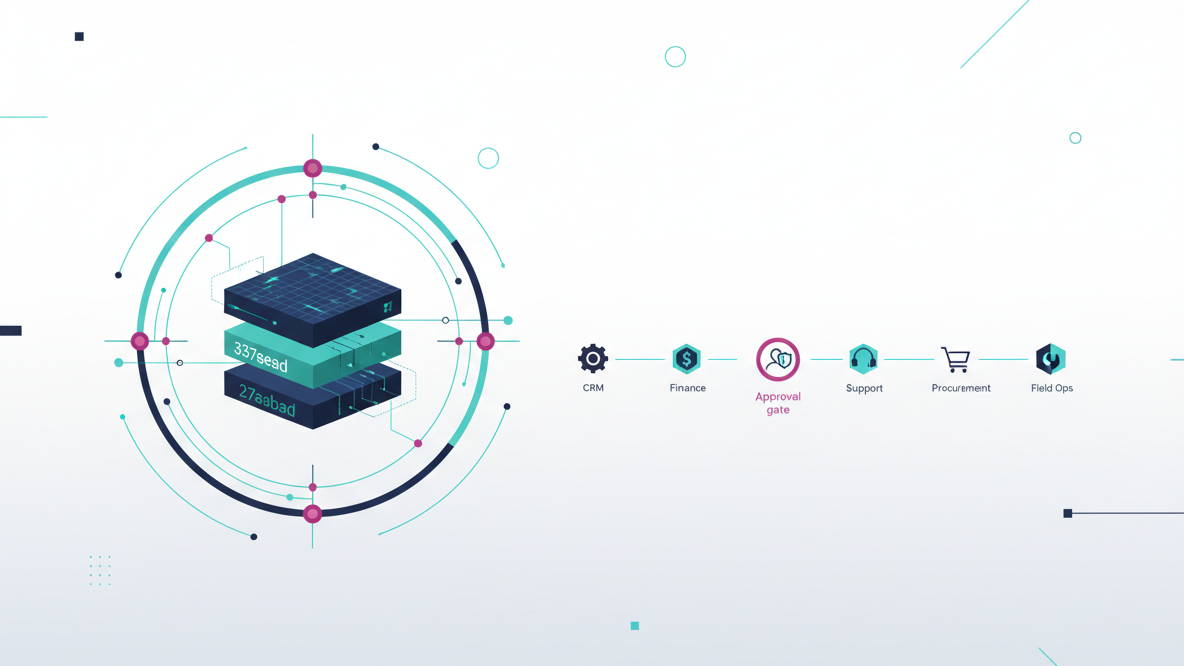
A context-engineered real estate platform is not built around modules (“CRM”, “Procurement”, “Facilities”). It’s built around decision moments — the points where the organisation commits capital, time, or risk.
Examples of high-leverage decision moments:
- Land acquisition: underwriting assumptions, comparable evidence, approval trail
- Design changes: impact on budget, schedule, compliance, and downstream procurement
- Variations/claims: status, approvals, contract linkage, cost-to-complete impact
- Procurement: vendor performance, compliance, lead times, budget availability
- Sales/leasing: pipeline integrity, pricing governance, incentives, conversion velocity
- Collections: dispute reasons, payment schedules, escalation playbooks
- Facilities: asset utilisation, maintenance cycles, tenant experience signals
- Investor reporting: consistent definitions, auditability, narrative + numbers
The goal is to ensure each decision is made with:
- the correct state of the asset/project
- the relevant constraints (budget, contract, approvals)
- the history (why we decided this last time)
- the consequences (cash, schedule, risk)
That is context: not more data, but decision-ready truth.
The human system behind the software: why roles matter
The article’s most important point is that software value is not produced by code alone. It’s produced by a delivery system that keeps reality connected to the roadmap.
Forward Deployment Engineering: bringing the site back into the product
Real estate is physical. The truth lives on sites, in approvals, in contractor behaviour, and in the friction between plan and reality. Forward Deployment Engineers reduce the gap between “what the software assumes” and “what the business actually does.”
They:
- observe workflows in the field
- translate operational constraints into product requirements
- validate whether features reduce cycle time or just add clicks
DevOps: dependable releases in a risk-sensitive environment
Real estate systems touch money, contracts, and compliance. DevOps isn’t optional — it’s how you ship safely.
- secure pipelines and access control
- observability (logs, metrics, tracing) for accountability
- reliable deployments that don’t disrupt operations
Full-stack engineering: connecting journeys across functions
A user journey in real estate rarely stays in one department. A variation touches site, procurement, finance, and reporting. Full-stack developers ensure the journey is coherent end-to-end.
Architecture and backend: scalable integrations and trustworthy transactions
Architects and backend engineers design:
- data models that reflect projects, assets, contracts, and milestones
- integrations with ERP, banking, document management, and CRMs
- transaction logic that is secure, auditable, and resilient
QA and testing: validating the real workflow, not the happy path
Testing is where context becomes real. The goal is not “does the feature work,” but “does it work under real constraints: partial approvals, missing documents, late changes, and exceptions.”
What economic momentum looks like in practice
Economic momentum is not a slogan. It’s a set of compounding effects:
- fewer surprises → fewer emergency decisions
- faster cycles → faster cash conversion
- cleaner governance → lower risk premium
- better visibility → better capital allocation
Over time, the organisation becomes easier to finance, easier to operate, and easier to scale.
Deventure’s stance: software as a multiplier, not a replacement
Deventure.co's', position is strategically correct: custom software doesn’t replace real estate expertise. It amplifies it.
Real estate expertise is the strategy. Custom software is the operating system that makes that strategy executable at scale — with discipline, visibility, and repeatability.
The organisations that win won’t be the ones with the most tools. They’ll be the ones whose operating model is coherent enough to compound.
Closing thought: build the system that makes good decisions inevitable
Markets will remain cyclical. But operational excellence can be engineered.
When you turn real estate operations into a connected product — designed around decision moments, grounded in field reality, and shipped with dependable engineering — you don’t control sentiment. You control execution.
And execution is where economic momentum is born.