

Many organisations pursue growth by adding more people, more meetings, and more tools. But sustainable growth rarely comes from accumulation. It comes from increasing the organisation’s ability to execute repeatedly with greater precision.
That’s why custom software—when approached as an operating model decision, not an IT project—can become a strategic lever. It helps organisations move from capability transformation (what you can do) to capacity building (how consistently and widely you can do it without friction).
The real constraint: execution doesn’t compound by default
Most leadership teams don’t lack ideas, domain expertise, or ambition. What they lack is a system where that expertise compounds.
In many companies, execution is limited by:
- Fragmented workflows spread across email, spreadsheets, chat, and disconnected tools
- Manual coordination that depends on a few “hero” individuals
- Decisions made on partial data, delayed reporting, or inconsistent definitions
- Knowledge trapped in people’s heads rather than embedded in repeatable processes
In this environment, growth increases complexity faster than it increases output. The organisation becomes busy, but not necessarily effective.
Custom software addresses this by turning intent into operating behaviour.
Capability transformation: redefining what the organisation can reliably do
Capability transformation begins when an organisation upgrades its ability—not by hiring more experts, but by removing the systemic friction that prevents experts from performing at their best.
1) Turning workflows into designed systems
When work is executed through ad-hoc coordination, every cycle is reinvented. Custom software makes workflows explicit:
- Inputs are defined
- Steps are structured
- Ownership is clear
- Exceptions are handled intentionally
This doesn’t “bureaucratise” work. Done well, it reduces cognitive load and makes execution smoother—especially in cross-functional processes like onboarding, delivery, compliance, procurement, or customer support.
2) Converting decisions into data-informed routines
Many organisations have data, but not decision-quality data. Custom software can align:
- Data capture at the source (where work happens)
- Shared definitions (what counts as “done,” “blocked,” “at risk”)
- Real-time visibility (so teams act before issues escalate)
The result is not just better reporting—it’s faster, more consistent decision-making.
3) Embedding institutional knowledge beyond individuals
In fast-growing teams, knowledge often sits with a few people:
- The project manager who knows how delivery really works
- The finance lead who understands edge cases
- The senior engineer who knows the system’s “gotchas”
Custom software helps encode that knowledge into the operating environment:
- Guardrails and validation rules
- Standardised templates and playbooks
- Automated checks and approvals
- Contextual guidance inside the workflow
This is how organisations reduce dependency on heroics and increase reliability.
4) Creating alignment through shared execution visibility
Capability isn’t only about skill—it’s about coordination. Custom software creates alignment by making execution observable:
- Who owns what
- What is blocked and why
- What has changed since yesterday
- What needs escalation
When visibility is built into the system, accountability becomes natural rather than performative.
Why transformation alone isn’t enough
Many organisations successfully improve how they operate in one team or one business unit—but struggle when they try to scale it.
That’s the difference between capability and capacity.
- Capability is “we can do this well.”
- Capacity is “we can do this well repeatedly, across more volume and complexity, without slowing down.”
- Capacity building is where custom software becomes a multiplier.
Capacity building: making new capabilities repeatable at scale
Capacity building starts when the organisation can extend its upgraded way of working across larger teams, more customers, more products, and more geographies—without creating operational drag.
1) Automation: removing repetitive work that steals throughput
When work is executed through ad-hoc coordination, every cycle is reinvented. Custom software makes workflows explicit:
Scaling through people alone increases coordination cost. Automation reduces it.
Custom automation can:
- Eliminate manual handoffs (status updates, approvals, reminders)
- Steps are structured
- Reduce rework through validation and consistency checks
- Trigger downstream actions instantly (notifications, provisioning, invoicing, reporting)
The point is not to “replace humans.” It’s to free humans to do higher-leverage work—problem solving, customer outcomes, and innovation.
2) Workflow orchestration: increasing throughput without chaos
As volume grows, the bottleneck shifts from individual productivity to system-level flow.
Custom software can orchestrate work across teams by:
- Routing tasks based on rules and context
- Balancing workloads and prioritisation
- Managing dependencies across functions
- Making queues and constraints visible
This is how organisations increase throughput without turning operations into a constant firefight.
3) Embedded governance: scaling consistency without slowing down
Governance often gets a bad reputation because it’s introduced as a layer on top of work. Custom software can embed governance inside work.
Examples include:
- Policy enforcement through rules, not reminders
- Audit trails that are automatic, not manual
- Approval flows that are contextual, not bureaucratic
- Role-based access and segregation of duties by design
This allows organisations to scale with confidence—especially in regulated industries or enterprise environments.
4) Operational intelligence: exposing bottlenecks before they become constraints
At scale, small inefficiencies become major constraints. Custom software can provide operational intelligence by:
- Tracking cycle time and throughput per workflow stage
- Identifying recurring failure modes and exception patterns
- Surfacing leading indicators (not just lagging metrics)
- Enabling continuous improvement loops
Over time, the organisation becomes self-correcting—able to see friction early and remove it systematically.
Digital leverage: why custom software is different from “more tools”
Off-the-shelf tools are valuable, but they often optimise isolated functions. Growth challenges are rarely isolated.
Custom software creates digital leverage because it is designed around:
- Your specific operating model
- Your cross-functional workflows
- Your definitions of quality, risk, and success
- Your customers’ experience end-to-end
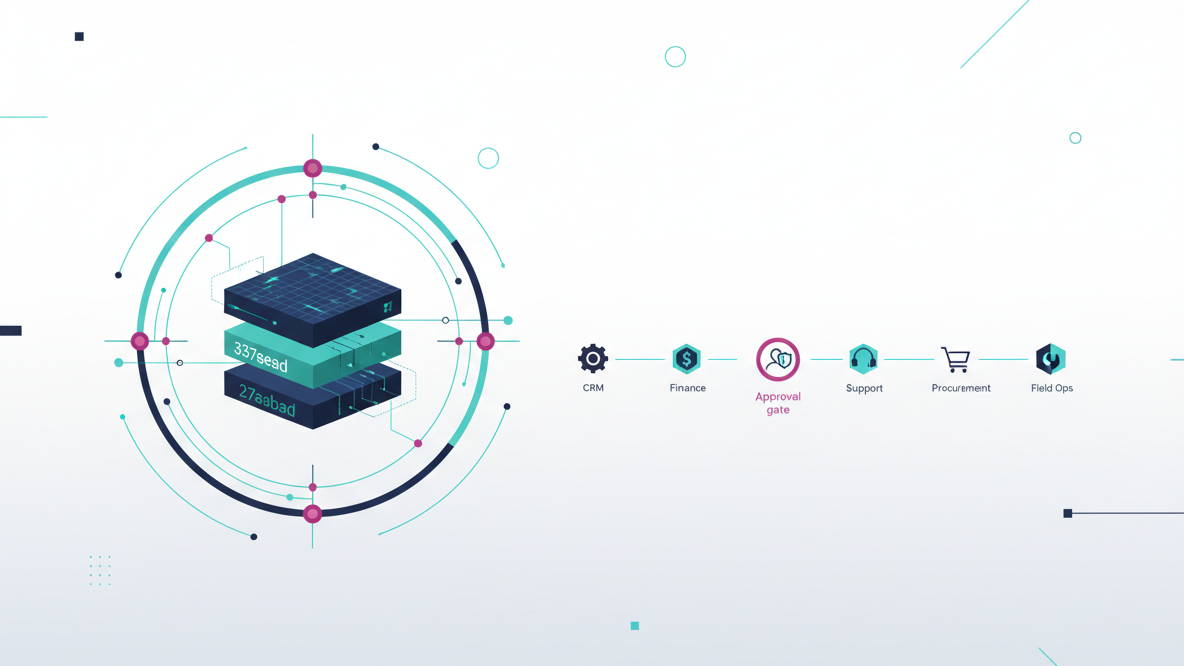
It becomes the connective tissue between teams, systems, and decisions.
This is the shift: software stops being technology infrastructure and becomes organisational infrastructure.
What this looks like in practice: a simple maturity path
Organisations typically move through a few stages when using custom software as a capacity lever:
- Visibility first: unify data and create a shared view of work
- Standardisation next: define workflows, roles, and quality gates
- Automation and orchestration: remove repetitive work and manage flow
- Intelligence and optimisation: instrument processes and continuously improve
- Scalable capacity: replicate the model across teams, units, and geographies
The goal isn’t to build software for its own sake. It’s to build a system that makes execution repeatable.
The strategic outcome: scaling through systems, not effort
When custom software is built as a strategic lever, organisations stop scaling through effort alone and begin scaling through systems.
- Teams spend less time coordinating and more time delivering
- Quality becomes consistent, not dependent on individuals
- Decisions become faster because data is trustworthy and timely
- Growth becomes less fragile because operations are designed to absorb complexity
That’s the moment capability transformation becomes capacity building.
And that’s when custom software becomes a competitive advantage—not because it is “custom,” but because it encodes how your organisation executes.
Deventure’s perspective: building organisational infrastructure
At Deventure.co, we see custom software as a true enabler of this shift by creating digital leverage:
- Automation removes repetitive work
- Workflow orchestration improves throughput
- Embedded governance strengthens consistency
- Operational intelligence exposes bottlenecks before they become constraints
The result is an organisation that can grow without losing precision.
Custom software, done right, doesn’t just support the business.
It becomes the business’s operating system.