

The last decade rewarded enterprises that could digitize. They modernized core systems, moved workloads to the cloud, connected data sources, and replaced paper-heavy processes with software. That era created a baseline.
Now the baseline is everywhere.
In most industries, “we’re doing digital transformation” is no longer a differentiator—it’s table stakes. The next decade will be defined by something harder to copy: speed of execution and speed of delivery at scale.
Not speed as a slogan. Speed as an organizational capability.
From connected systems to transformed behavior
Digital transformation connected systems. The next phase transforms organizational behavior.
Markets are compressing decision windows. Customer expectations are rising in three directions at once:
- Faster fulfillment
- Faster responses
- Faster innovation cycles
And on top of that: increasingly personalized outcomes.
Enterprises are no longer measured only by what they can produce, but by how quickly they can repeatedly deliver value without degrading quality.
That “repeatedly” is the key word. Anyone can sprint once. The winners will be the organizations that can run fast every day, across every team, across every customer touchpoint.
The new competitive advantage: capability building at scale
If the first wave was about digitizing operations, the next wave is about capability building at scale.
Capability is not a tool. It’s not a platform. It’s not a department.
Capability is what an organization can do reliably, predictably, and repeatably—even as volume increases, complexity grows, and conditions change.
In the next decade, enterprises will compete on capabilities like:
- Turning customer signals into decisions quickly
- Coordinating execution across functions without friction
- Launching new offerings without breaking existing operations
- Maintaining quality while increasing throughput
- Learning from outcomes and improving the system continuously
These are not “digital projects.” They are operating behaviors.
Why speed becomes the strategy
Speed is often misunderstood as moving faster inside a single team. But enterprise speed is different.
Enterprise speed is the distance between decision and delivery.
It’s the time it takes to:
- Detect what’s happening (signal)
- Decide what to do (judgment)
- Execute the work (delivery)
- Validate the outcome (feedback)
If any one of these steps is slow, the whole organization feels slow—no matter how hard individuals work.
That’s why the next decade belongs to enterprises that don’t just “work harder.” They engineer speed into the system.
Custom software as the strategic lever
This is where custom software becomes a strategic lever.
Off-the-shelf tools are great for standard workflows. But when the competitive advantage is tied to how you execute, standardization becomes a ceiling. Enterprises hit a point where they can’t buy their way into differentiation.
Custom software changes the equation because it can be designed around your execution model:
- Your decision logic
- Your operating constraints
- Your customer promises
- Your compliance needs
- Your internal dependencies
Custom software is not “code for code’s sake.” It is a way to embed capability into the organization.
The lever model: capability transformation as the fulcrum, capacity building as the multiplier
Think of the next decade through a simple lever model:
- Capability transformation is the fulcrum
- Capacity building is the force multiplier
- Custom software is the lever
1) Capability transformation: turning intent into operating behavior
Most enterprises have intent. They want to be customer-centric, data-driven, efficient, responsive, compliant, innovative.
But intent is not behavior.
Capability transformation is what turns intent into how work actually happens—day to day, team to team, decision to decision.
Custom software enables this by embedding:
- Decision logic (what should happen when X occurs)
- Operational intelligence (what’s true right now, with context)
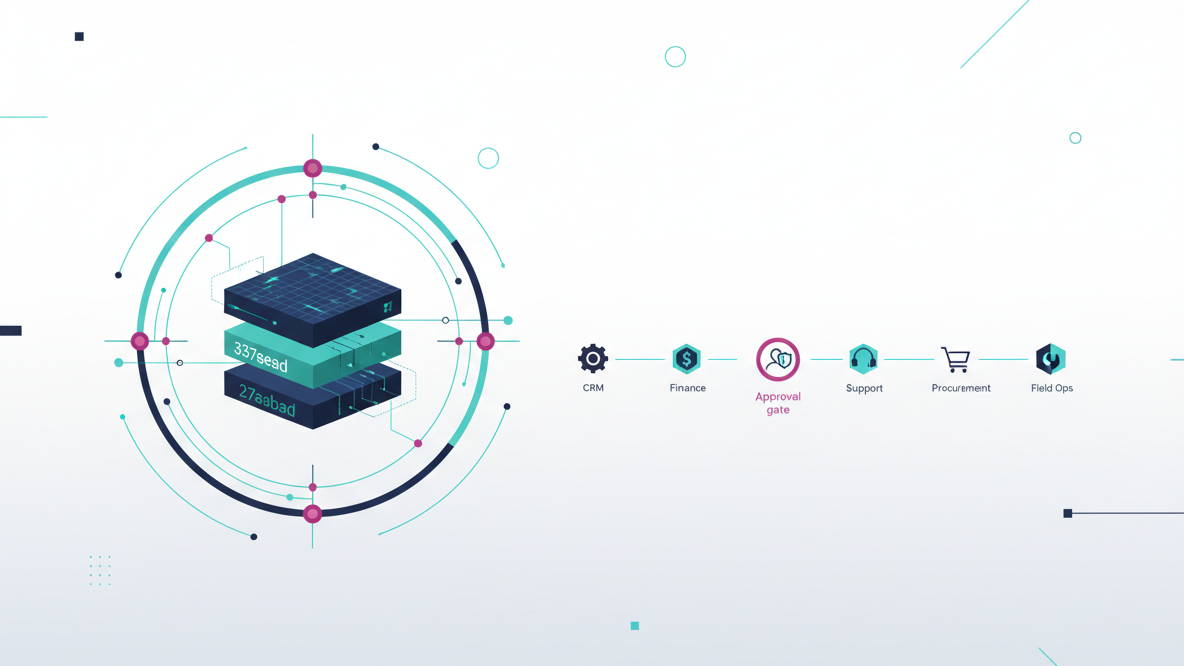
- Process orchestration (how work moves across people and systems)
- Execution discipline (guardrails, approvals, SLAs, quality checks)
Instead of relying on tribal knowledge, heroics, or manual coordination, the enterprise institutionalizes capability.
When capability transformation happens, execution stops being personality-driven and becomes system-driven.
A few examples of what that looks like in practice:
- A sales team responds faster because information arrives with context, not just raw data.
- Operations executes with fewer dependencies because handoffs are explicit and automated.
- Service resolves issues faster because visibility is shared and root causes are traceable.
- Leadership allocates resources with precision because capacity and constraints are measurable.
This is the shift: the organization becomes more capable without requiring everyone to become a superhero.
2) Capacity building: converting capability into repeatable outcomes
Capability alone does not create growth.
Capacity building is what converts capability into repeatable outcomes at scale.
Without capacity, capability stays trapped in pockets:
- One team has a great process, but it doesn’t replicate.
- One region performs well, but global rollout collapses.
- One product line is efficient, but adjacent lines remain manual.
Custom software enables capacity building by making high-performing execution models replicable across:
- Departments
- Geographies
- Partner ecosystems
- Customer touchpoints
And crucially: without proportional increases in cost or operational friction.
One successful operating pattern becomes many.
This is how execution compounds.
Why enterprises have reached the digital transformation threshold
Many enterprises have already done the “big moves”:
- Cloud migration
- ERP and CRM modernization
- Data warehouses and dashboards
- Automation pilots
- Collaboration tooling
Yet customers still experience delays. Teams still chase information. Leaders still make decisions with partial visibility. Delivery still depends on coordination overhead.
That’s because the threshold wasn’t about technology adoption—it was about behavioral transformation.
The next phase is not “more tools.” It’s better systems of execution.
And those systems are built when software is designed to:
- Reduce ambiguity
- Reduce handoff friction
- Reduce time-to-decision
- Reduce rework
- Increase learning velocity
The compounding effect: how speed creates trust and momentum
Speed is not just operational. It’s strategic.
- Speed of execution creates trust. Customers trust organizations that respond quickly, keep promises, and resolve issues without drama.
- Speed of delivery creates market momentum. Faster delivery means faster feedback, faster iteration, and faster capture of demand.
When an enterprise reduces the distance between decision and delivery, it doesn’t just move faster—it becomes harder to compete against.
Competitors can copy features. They struggle to copy execution.
What “delivering at scale” really means
Delivering at scale is not “doing more.” It’s doing more without breaking.
It means:
- Higher volume without quality degradation
- More personalization without chaos
- More offerings without operational overload
- More customers without linear headcount growth
This is where custom software shines: it allows enterprises to build a delivery engine that scales through systems, workflows, and institutional knowledge—not people alone.
The next decade: the execution era
The next decade belongs to organizations that master capability building at scale.
They will:
- Engineer speed into workflows
- Embed decision-making into systems
- Make execution repeatable across the enterprise
- Scale outcomes without scaling friction
And at the center of that equation is custom software—built not as an IT initiative, but as an operating advantage.
Because when capability transformation becomes the fulcrum and capacity building becomes the multiplier, execution compounds.
Speed of execution creates trust. Speed of delivery creates market momentum. Capability transformation creates the foundation. Capacity building creates sustainable growth at scale.
Custom software turns enterprise potential into repeatable enterprise performance.