

The old geometry: capability as a place you had to go
For most of enterprise history, capability was destination-bound. Work happened where the systems lived, where the approvals sat, where the forms were stored, and where the “right people” could be found. Customers travelled to service desks. Employees travelled to offices. Field teams travelled back to headquarters—physically or digitally—just to move a request forward.
In that model, value was rarely experienced at the moment of need. It arrived later, after handoffs, queues, and coordination. The organisation’s power existed, but it was trapped behind locations, departments, and rigid workflows.
Custom software changed the geometry.
Not because it digitised forms or automated tasks—those were early wins. It changed the geometry because it made capability deployable. It made enterprise power something that could appear where the moment emerges.
The shift: from destination-based execution to context-aware deployment
If every moment is a slice of time inside an environment—defined by constraints, intent, and circumstance—then modern enterprise capability is increasingly judged by one question:
Can the organisation activate the right outcome inside that slice of time?
Custom software enables a transition away from “go to the system” toward “the system comes to the moment.” Capability can now appear relative to:
- Physical space (on-site, in-transit, at the edge)
- Circumstance (what is happening right now)
- Constraints (time, compliance, availability, risk)
- Intent (what the user is trying to accomplish)
- Emerging scenarios (events that were not fully predictable)
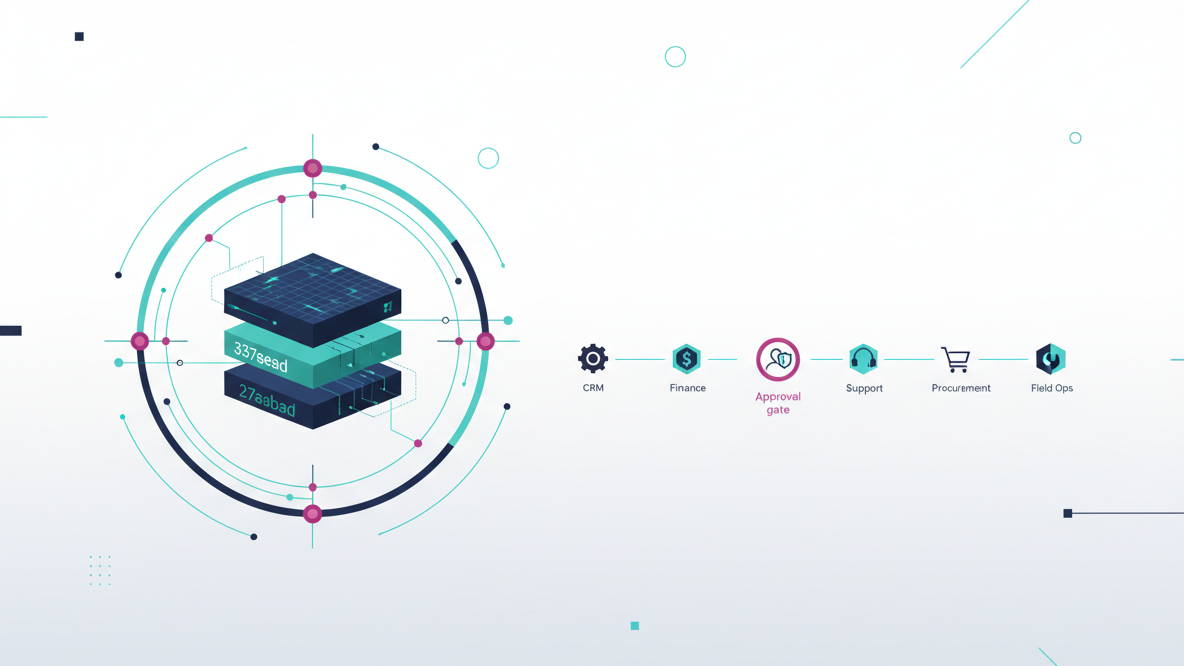
This is not a UX trend. It is an architectural and operational shift: the enterprise becomes less like a building and more like a responsive layer.
Why distance collapses: three compressions happening at once
Distance collapses when the gap between intent and outcome shrinks. Custom software accelerates that shrinkage through three forms of compression.
1) Compression of access
Authentication, identity, and permissions used to be gates that slowed everything down. Now, low-friction authentication and policy-driven access make it possible to expose capability safely in more places.
Instead of “you can only do this from inside the network,” organisations can move toward:
- Contextual access (who you are + what you’re doing + where you are)
- Role- and risk-aware permissions
- Secure-by-default pathways that don’t require constant manual approvals
This is how capability becomes portable without becoming dangerous.
2) Compression of integration
Enterprises historically rebuilt the same infrastructure repeatedly because systems couldn’t talk. Custom software—when built with API-led connectivity and interoperable rails—turns integration into a reusable asset.
When integration becomes a product, not a project, the organisation stops “starting over” every time a new scenario appears.
That is the difference between:
- Building a one-off workflow for a single department
- Building a capability layer that multiple moments can call into
3) Compression of decision-making
The slowest part of many processes isn’t execution—it’s coordination. Who decides? Who approves? Who has the latest data? Who is accountable?
Custom software can embed decision logic into the flow of work:
- Rules and policies applied consistently
- Human approvals triggered only when needed
- Real-time visibility across teams
- Audit trails that reduce fear-driven friction
When decisions are orchestrated across environments, the enterprise becomes faster without becoming reckless.
Capability as a responsive layer, not a fixed asset
In the destination-bound world, products and internal tools behave like fixed assets: stable, centralised, and accessed on their terms.
In the context-aware world, products and services behave like responsive layers:
- They activate when demand appears
- They adapt to constraints
- They expose only what is needed
- They connect to existing systems rather than replacing everything
This is why the most valuable custom software is not “an app.” It is a capability surface.
A capability surface is the difference between:
- A CRM that stores data
- A customer system that can trigger outcomes (quote, configure, approve, onboard, renew) in real time
It’s the difference between:
- A ticketing tool that logs issues
- A field platform that can resolve issues on-site by orchestrating inventory, dispatch, compliance, and customer communication
Concrete moments where context-aware capability wins
This shift becomes real when you look at moments, not departments.
Field operations: the enterprise at the edge
A field technician is no longer “outside the organisation.” With context-aware custom software, they can:
- Trigger enterprise workflows in real time
- Validate compliance on-site
- Capture evidence and sync automatically
- Escalate only when thresholds are crossed
The organisation’s capability travels with them.
Customer self-activation: outcomes without queues
Customers increasingly expect to configure, transact, and activate outcomes instantly. Custom software enables:
- Guided configuration based on intent
- Real-time eligibility and pricing checks
- Automated provisioning and onboarding
- Support that is embedded, not bolted on
The customer doesn’t enter the queue; the outcome appears where the intent emerges.
Cross-team orchestration: decisions without rebuilding
When teams can orchestrate decisions across environments—without recreating infrastructure every time conditions change—enterprises gain a new kind of scale:
- Scale of responsiveness
- Scale of reuse
- Scale of learning
This is the difference between growth that adds complexity and growth that adds capability.
The enterprise of the future: defined by precision, not just size
For decades, enterprise advantage was associated with scale: more people, more locations, more systems, more process.
But scale alone can become drag.
The enterprise of the future may be defined by how precisely it can deploy capability into each slice of time—how quickly it can sense a moment, interpret it, and activate the right outcome.
That precision requires more than buying tools. It requires building an operating layer that fits the organisation’s reality:
- Its workflows
- Its constraints
- Its regulatory environment
- Its customer expectations
- Its internal accountability
That is why custom software becomes more than technology.
It becomes the operating layer for modern enterprise responsiveness.
What “good” looks like: principles for building context-aware capability
To make this shift real (and sustainable), custom software needs to be designed as a capability layer, not a collection of features.
- Design for moments, not org charts: start with scenarios and slices of time.
- Build reusable rails: identity, permissions, integration patterns, auditability.
- Expose capability through APIs: so new channels can call into the same outcomes.
- Instrument everything: measure latency from intent to outcome.
- Keep humans where judgment is needed: automate the rest.
When these principles are applied, distance collapses—not because the world gets smaller, but because the enterprise becomes present.
Closing: where the moment emerges
What matters is no longer where the organisation exists.
What matters is where the moment emerges.
Custom software is the mechanism by which capability becomes situational—activated by context, constrained by policy, and delivered at the point of need.
In that world, technology stops being a back-office function.
It becomes the enterprise’s ability to show up—precisely, safely, and immediately—inside each slice of time.