

Custom software is ingrained in an enterprise, enabling each individual in the enterprise operations with a 360-degree perspective of their job function, enabling them to position themselves better for enterprise performance and personal growth.
The enterprise problem isn’t effort—it’s fragmentation
Most enterprises don’t fail because teams aren’t working hard. They fail because, as the organization grows, information, context, accountability, and decision authority fragment across departments.
The symptoms are familiar:
- Leadership sees lagging indicators, not the real drivers.
- Teams optimize locally, but the enterprise underperforms globally.
- Decisions slow down because no one trusts the “single source of truth.”
- Execution becomes a chain of handoffs, not a coordinated system.
This is where many digital transformation initiatives stall. Not because technology is missing, but because the operating model is missing a shared, role-relevant view of reality.
Custom software is more than a system of record
Packaged tools often excel at standard workflows. But enterprises rarely struggle with the standard parts of work. They struggle with the intersections:
- Where sales commitments meet delivery capacity
- Where operational constraints meet customer expectations
- Where finance planning meets execution realities
- Where product priorities meet commercial urgency
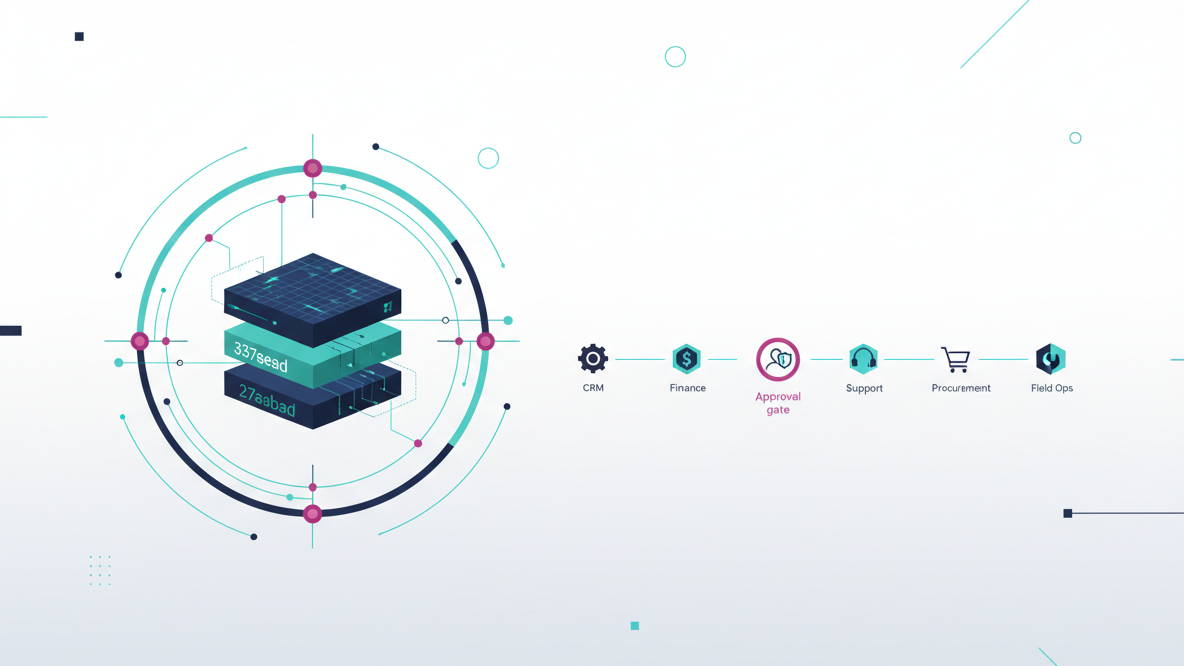
When thoughtfully designed, custom software becomes an operational layer—a connective tissue across functions that turns scattered data into shared context.
Instead of “another tool,” it becomes the place where:
- Work is coordinated
- Trade-offs are made visible
- Accountability is clarified
- Decisions are supported with real-time context
In other words, it creates a 360° enterprise view—not as a dashboard gimmick, but as a practical, role-based perspective that aligns people to outcomes.
What “360° visibility” actually means (by role)
A true enterprise view is not one screen that everyone shares. It’s one reality, expressed differently depending on responsibility.
Executives: strategic visibility that supports long-horizon decisions
Executives need more than reporting. They need clarity on:
- Strategic performance indicators and leading signals
- Capital allocation efficiency and opportunity cost
- Growth opportunities and portfolio trade-offs
- Risk exposure across delivery, compliance, and customer health
Custom software can unify these signals into a coherent picture—so leadership can steer proactively rather than react to surprises.
Business leaders: operational intelligence tied to measurable outcomes
Business leaders live in the space between strategy and execution. They need to see:
- Which initiatives are moving the needle
- What constraints are limiting outcomes
- Where cross-team dependencies are slowing progress
- How execution maps to business results
When software links initiatives to outcomes, leaders stop debating anecdotes and start managing the system.
Managers: real-time control over execution
Managers need practical control:
- Execution velocity and throughput
- Resource utilization and capacity planning
- Bottlenecks and queue health
- Interdepartmental dependencies and handoff friction
With shared operational context, managers can reduce firefighting and increase predictability.
Individual contributors: context that turns tasks into impact
The biggest hidden cost of fragmentation is what it does to the people doing the work.
When contributors only see tasks, they become isolated executors. But when they see context, they gain:
- Clarity on why the work matters
- Visibility into who depends on their output
- Understanding of downstream impact
- Opportunities to contribute beyond a narrow job description
This is how organizations move from “busy” to “aligned.”
The cross-functional alignment effect
The most powerful outcomes show up when functions stop operating as separate worlds.
Custom software can create shared visibility such that:
- Sales understands fulfillment realities (capacity, lead times, constraints)
- Operations understands customer expectations (SLAs, success criteria, escalation patterns)
- Engineering understands commercial priorities (revenue impact, churn risk, strategic accounts)
- Finance understands delivery constraints (true cost-to-serve, margin drivers, resourcing realities)
- Customer-facing teams understand lifecycle economics (retention levers, expansion timing, support cost)
This doesn’t just improve reporting. It changes behavior.
The behavioral shift: from functions to systems
When people share context, they start thinking in systems.
That shift produces compounding benefits:
- Better decision-making because trade-offs are visible
- Distributed ownership because accountability is clear
- Faster execution because dependencies are managed, not discovered late
- Higher trust because teams operate from the same facts
Over time, the enterprise becomes less dependent on heroic effort and more dependent on a reliable operating system.
The talent outcome: from task execution to strategic participation
A 360° view doesn’t only benefit the enterprise. It benefits individuals.
When contributors can see how work connects to outcomes, career development becomes more intentional:
- Skill gaps are identified earlier
- Adjacent growth opportunities become visible
- People can position themselves for internal mobility
- Leadership readiness improves because context is built into daily work
This is how software supports not just productivity, but institutional knowledge retention and long-term capability building.
What the strongest custom software deployments do differently
The best deployments are not defined by features. They are defined by intent.
They don’t simply digitize work. They:
- Embed the organization’s operating model into workflows
- Make decision authority explicit
- Create shared definitions for metrics and outcomes
- Reduce handoffs by designing for end-to-end value streams
- Deliver role-based context, not generic dashboards
Most importantly, they are built as partnerships—where the software team takes ownership of the business outcome, not just the delivery.
A practical way to think about it
If your teams are working hard but still feel misaligned, it’s rarely a motivation problem.
It’s a visibility and coordination problem.
Custom software, when designed as an operational layer, helps every person answer three questions—every day:
- Where do I stand?
- Where is the enterprise going?
- How can I grow with it?
That’s what a real 360° enterprise view delivers: alignment, scalable growth, and a pathway from execution to strategic participation.
Closing thought
The goal isn’t “more software.” The goal is a better enterprise operating system—one that aligns people, growth, and purpose through shared context.
If you’re seeing fragmentation across departments, the opportunity isn’t to add another tool. It’s to design the connective layer that makes the enterprise move as one.