

Enterprises don’t lose to competitors because they lack software. They lose because their software can’t change at the speed of the business. Markets shift, regulations tighten, customer expectations rise, and internal workflows evolve. In that reality, the most valuable capability isn’t a feature set—it’s adaptability.
A full-stack custom software product built on a microservices architecture turns adaptability into an engineered property of the enterprise. It creates a stable core platform that can be extended continuously through small, purpose-built “micro products” deployed directly into the workflow. This is the environment where Forward Deployment Engineers (FDEs) thrive: close to business users, shipping targeted capabilities fast, and converting operational friction into compounding advantage.
Why custom software is uniquely powerful in an enterprise
Packaged platforms are designed for the “average” company. Enterprises are not average. They have unique process variations, risk profiles, compliance constraints, data realities, and organizational incentives. Over time, the gap between “how the business must operate” and “what the software allows” becomes the true cost center.
Custom software closes that gap because it is:
- Workflow-native: it can be built around how work actually happens, not how a vendor assumes it happens.
- Domain-specific: it encodes the enterprise’s unique logic, rules, and edge cases as first-class product behavior.
- Composable: it can be structured as modular services and capabilities rather than a single monolith of tightly coupled change.
- Governable: it can enforce security, auditability, and compliance in ways that match the enterprise’s realities.
The “power” of custom software is not just that it can do anything—it’s that it can evolve without breaking itself.
Microservices: the architecture that makes change safe
Microservices matter here because they separate the enterprise platform into independently deployable units. That separation is not a technical trend; it’s a change-management strategy.
When the core platform is microservices-based:
- Change becomes localized: new requirements often map to a single bounded context instead of rippling across the entire system.
- Teams can ship independently: releases are smaller, safer, and more frequent.
- Risk is contained: failures degrade a slice of capability, not the whole business.
- Scaling is precise: you scale the bottleneck service, not the entire application.
This architecture creates the conditions for micro products: small applications or extensions that wrap, orchestrate, or enhance specific modules without destabilizing the foundation.
The micro product concept: extending the core without rewriting it
Enterprises often treat every new requirement as a “core platform change.” That creates slow cycles, heavy governance, and high regression risk. Micro products flip the model.
A micro product is a lightweight, purpose-built capability that:
- targets a specific operational problem (intake, approvals, routing, compliance checks, exception handling)
- integrates with the core platform through APIs/events
- can be deployed, iterated, and retired independently
- lives close to the workflow where the pain occurs
Instead of modifying the core every time the business changes, the enterprise builds a growing layer of operational intelligence around the core. The core remains stable; the edges evolve.
Why Forward Deployment Engineers are the catalyst
Forward Deployment Engineers sit at the intersection of product, engineering, and operations. Their advantage is proximity: they observe the real workflow, not the theoretical one.
In an enterprise environment, FDEs enable a high-leverage loop:
- Observe: how work is actually done, where decisions stall, where exceptions explode.
- Model: translate operational reality into a small, testable capability.
- Deploy: ship a micro product into the workflow quickly.
- Measure: capture throughput, error rates, cycle time, adoption, and compliance outcomes.
- Refine: iterate continuously until the workflow becomes smoother and more predictable.
This turns change management into a continuous engineering discipline—not a disruptive transformation program.
Any stack enterprises: why micro products still work everywhere
Most enterprises already have a technology ecosystem: Microsoft/.NET, Java, SAP, Oracle, Salesforce, or a mix. The key is that micro products are not a replacement strategy—they are an integration and evolution strategy.
Because micro products can be built as:
- API-first services
- event-driven consumers/producers
- workflow UIs that sit on top of existing systems
- automation layers that orchestrate across tools
They can coexist with almost any stack. FDEs don’t need to rewrite SAP or replace Salesforce to create value. They build around functional modules—connecting systems, enforcing rules, improving visibility, and reducing manual work.
The enterprise’s existing stack becomes the substrate. The custom microservices platform becomes the adaptive layer.
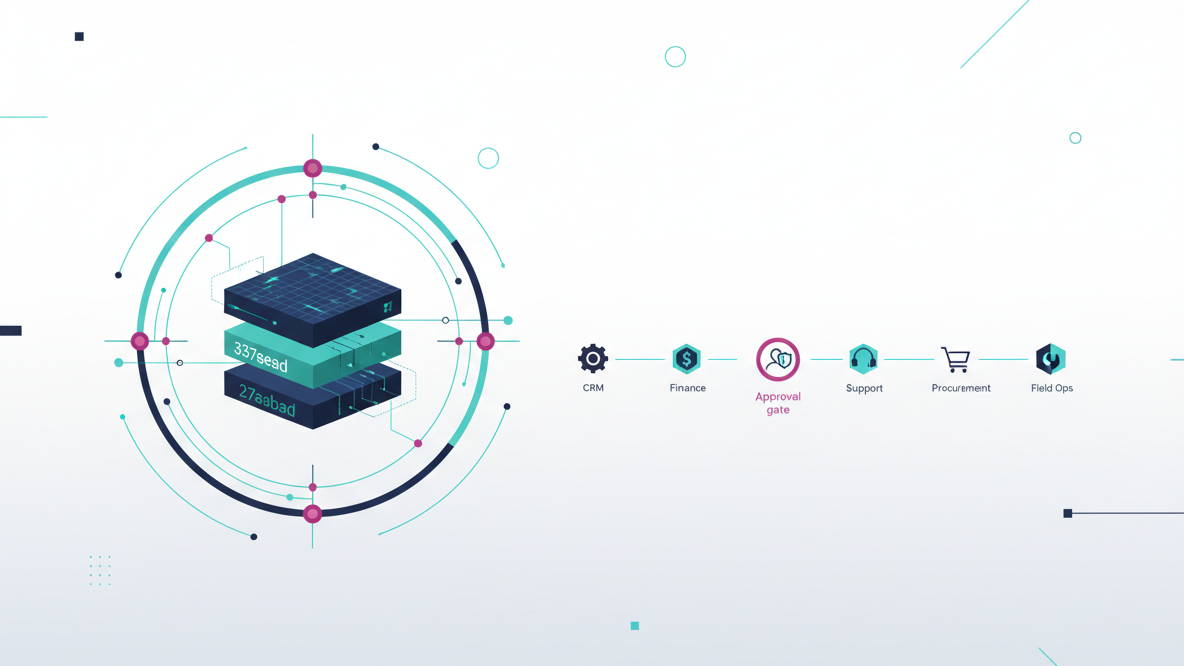
Where micro products create outsized operational leverage
Micro products are most powerful when they target high-friction, high-frequency, high-risk parts of the workflow:
- Intake and triage: standardize requests, route intelligently, reduce back-and-forth.
- Approvals and governance: enforce policy, capture audit trails, shorten decision cycles.
- Compliance and controls: embed checks into the process instead of after-the-fact policing.
- Exception handling: detect anomalies early, guide resolution, prevent repeat incidents.
- Operational visibility: real-time dashboards tied to operational truth, not manual reporting.
- Automation and orchestration: eliminate swivel-chair work across tools and teams.
Each micro product is small, but the portfolio effect is massive: the enterprise accumulates a library of capabilities that continuously reduces cycle time and increases reliability.
Stability of the core, agility at the edges
The strategic win is the separation of concerns:
- The core platform focuses on stability, security, data integrity, and long-term maintainability.
- The micro product layer focuses on speed, experimentation, and contextual workflow improvements.
This is how enterprises avoid the classic trap: either moving too slowly because everything is “core,” or moving too fast and breaking critical systems.
Microservices-based custom software enables both.
Change management becomes a product capability
Traditional change management is often a program: big initiatives, long timelines, heavy training, and organizational fatigue.
In a micro product model, change management becomes a product capability:
- Changes are smaller and easier to adopt.
- Feedback loops are tighter.
- Training is incremental and contextual.
- Rollbacks are possible.
- Adoption can be measured and improved.
Instead of “transforming the business” every few years, the enterprise continuously engineers itself.
The competitive advantage: compounding operational intelligence
Competitors can buy the same tools. They can hire similar talent. What’s hard to copy is a system that continuously converts operational reality into software improvements.
A custom microservices platform plus FDE-driven micro products creates a compounding advantage:
- faster response to market and regulatory change
- lower operational cost through reduced friction
- higher reliability through localized risk
- better customer experience through workflow precision
- stronger governance through embedded controls
Custom software doesn’t simply digitize business.
It creates an enterprise that can evolve on purpose—one micro product at a time.