

Most businesses don’t suffer from a lack of software. They suffer from software that was never designed around their operational intent.
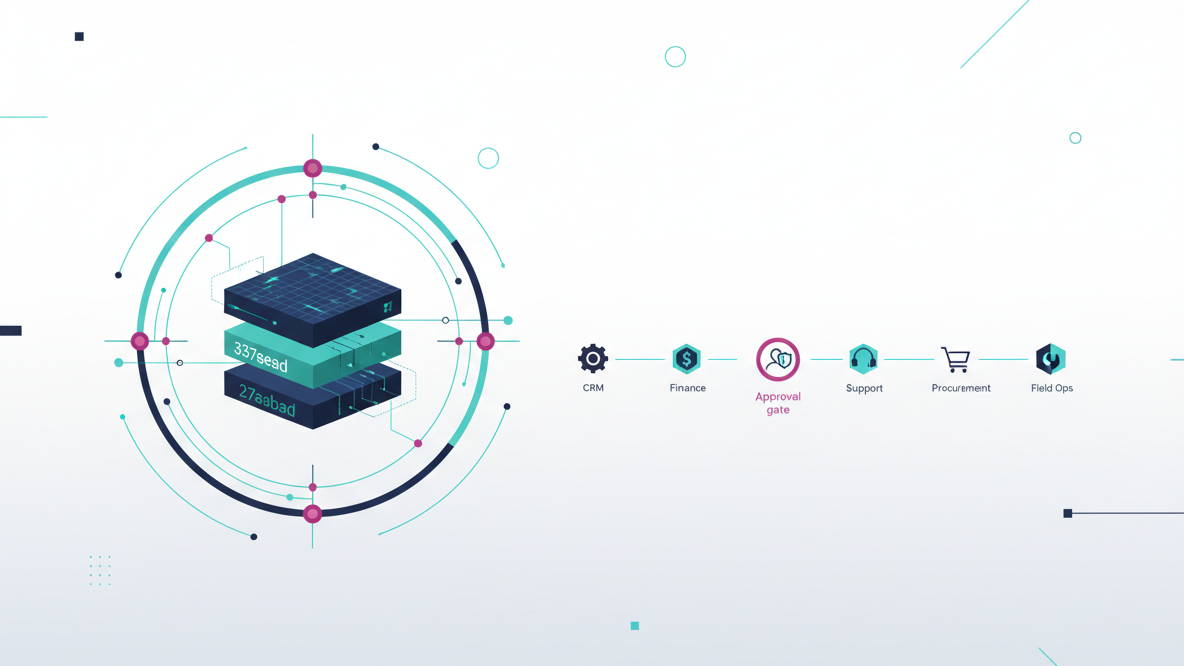
That distinction is the difference between tools that digitize work and platforms that run the business. Custom software becomes valuable when it stops behaving like a generic replacement (spreadsheets → app, emails → tickets, paper → forms) and starts behaving like operational infrastructure—engineered around how decisions are made, how work actually flows, and where friction quietly compounds.
The problem isn’t “manual work.” It’s misaligned assumptions.
Off-the-shelf products are built on averages: the average approval chain, the average sales cycle, the average compliance burden, the average org structure. That’s not a flaw—it’s the business model.
But operational reality is rarely average.
- Decisions don’t move in straight lines; they loop, escalate, and depend on context.
- Departments don’t “handoff” cleanly; they negotiate priorities, capacity, and accountability.
- Delays aren’t caused by a single bottleneck; they’re caused by micro-frictions that stack up.
- Scale doesn’t break because of traffic alone; it breaks because processes that worked at 20 people fail at 200.
When software is built on assumptions that don’t match how your company executes, you get a familiar pattern:
- Teams create workarounds.
- Data becomes inconsistent.
- Reporting becomes political (“whose numbers are right?”).
- Automation is avoided because it doesn’t reflect reality.
- The tool becomes a system of record, but not a system of execution.
Intentional custom software is the opposite. It encodes how the business should operate—and supports how it actually operates.
Intentional workflow architecture: every component has a job
The most expensive software is not the one with the most features. It’s the one with the most unnecessary features.
Intentional workflow architecture means every module, dashboard, API, and automation exists because it serves a specific operational purpose:
- A dashboard is not “visibility.” It’s a decision surface.
- A form is not “data capture.” It’s a control point.
- An integration is not “connectivity.” It’s a dependency that must be governed.
- An automation is not “efficiency.” It’s a policy encoded into execution.
This is where design becomes strategic. You’re not designing screens—you’re designing how work moves, how exceptions are handled, and how accountability is enforced.
A useful test: if you remove a feature, does the operation degrade? If not, it’s likely noise.
Domain-specific engineering: software that speaks the business
Generic software forces the business to translate itself into the tool. Intentional custom software does the reverse: it translates the business into a system.
Domain-specific engineering means the platform reflects:
- Your business model (how value is created, delivered, and captured)
- Industry constraints (compliance, auditability, data retention)
- Escalation hierarchies (who can override what, under which conditions)
- Execution realities (field work, after-hours operations, multi-time-zone teams)
- Risk tolerance (what must be controlled vs. what can be flexible)
This is where real leverage appears: the software stops being a neutral container and becomes a domain engine.
Instead of “status” fields, you get state machines that mirror real lifecycle transitions. Instead of generic permissions, you get role-based authority tied to responsibility. Instead of one-size-fits-all workflows, you get controlled variation—because operations are never identical across teams.
Scalability with structure: growth breaks processes before it breaks systems
Most teams think about scalability as a technical concern: performance, infrastructure, throughput.
But operational scalability is often the first thing to fail.
- More customers means more exceptions.
- More employees means more coordination cost.
- More products means more cross-team dependencies.
- More regulations means more evidence, traceability, and control.
Intentional platforms are designed to evolve with:
- Integrations (new tools, new data sources, new failure modes)
- Compliance requirements (audit trails, approvals, segregation of duties)
- Process maturity (from informal to standardized to optimized)
- Business expansion (new regions, new currencies, new legal realities)
This requires structure: clear domain boundaries, stable APIs, event-driven thinking where appropriate, and data models that anticipate change.
The goal is not to predict every future requirement. It’s to build a platform that can absorb change without becoming fragile.
Operational friction elimination: remove the hidden taxes
The objective of intentional custom software is not “adding a layer.” It’s removing the inefficiencies that already exist—especially the ones nobody names because they’ve become normal.
Operational friction often hides in:
- approvals that exist because trust is low or risk is unclear
- re-keying data between systems
- unclear ownership (“who is responsible for this step?”)
- exception handling done in private messages
- reporting that requires manual reconciliation
Intentional design treats friction like a system problem, not a people problem.
Instead of telling teams to “be more disciplined,” you redesign the workflow so discipline is the default:
- approvals become conditional and policy-driven
- exceptions become first-class flows, not side conversations
- handoffs become explicit with SLAs and ownership
- data becomes captured once, validated early, and reused everywhere
Over time, this compounds. You don’t just save minutes—you reduce the operational noise that drains focus and slows decision-making.
Institutional intelligence embedding: make the platform remember
The most underappreciated value of custom software is that it can embed institutional intelligence.
In many organizations, critical knowledge lives in:
- senior employees’ heads
- “how we do it” documents nobody reads
- tribal heuristics (“we always double-check these customers”)
- informal escalation rules
This is fragile. It doesn’t scale, and it creates dependency on individuals.
Intentional platforms capture and operationalize that intelligence:
- decision rules become explicit policies
- approvals reflect risk thresholds
- validations encode real-world constraints
- workflows guide new employees into correct execution
- audit trails preserve why decisions were made, not just what happened
The result is not rigidity. It’s resilience.
What the strongest custom software looks like in practice
The strongest custom software products are rarely the loudest. They don’t win by novelty; they win by alignment.
They quietly align people, processes, systems, and decisions into a cohesive execution engine.
- People know what to do next.
- Exceptions are handled without chaos.
- Data is trustworthy because it’s produced by the workflow.
- Leadership gets real visibility because operations are structured.
- The platform evolves as the business evolves.
That’s what “intentional by design” really means: software that reflects operational reality, not generic assumptions.
If your current tools require constant workarounds, it’s not a training problem. It’s a design problem.
And design—when tied to operational intent—is where custom software becomes a competitive advantage.
Operational friction isn’t only technical—it’s human
Generalized systems often create bloated interfaces and workflows. Every unnecessary click compounds fatigue, but the bigger cost is what it does to behavior:
- People avoid the system and keep shadow spreadsheets
- Teams delay updates because the workflow is painful
- Data quality drops because fields feel irrelevant
- Approvals become rubber-stamped because the process is too heavy
This is how software bloat becomes operational risk. The system may be “feature-rich,” but the organization becomes slower, less accurate, and less responsive.
The technical bloat behind the UI
Under the surface, generalized SaaS often carries heavy runtime overhead to support universality:
- Multitenancy isolation layers
- Plugin ecosystems and extension points
- Backward compatibility paths
- Feature toggles and experimentation frameworks
- Telemetry pipelines and event tracking
- Universal deployment models
These are rational design choices for a vendor. But they can increase:
- Latency across operational pipelines
- Memory utilization through middleware stacks
- Database load from generalized data models
- Complexity in debugging and incident response
That’s why even a single unnecessary database query, executed at enterprise scale, becomes measurable infrastructure overhead.
Custom software: snapping tightly into enterprise operations
This is where custom software changes the equation.
Instead of forcing the enterprise to snap into the software, the software snaps tightly into the enterprise—its workflows, reporting structures, reconciliation logic, approval hierarchies, and infrastructure environment.
When software is designed around a specific enterprise context:
- Every workflow exists with operational intent
- Every screen supports a real decision or action
- Every integration is purposeful, not optional noise
- Data models reflect the business, not a generic template
- CI/CD aligns with internal controls and release governance
You remove abstraction layers that exist only to serve universality. You reduce operational detours. You shorten execution paths.
Precision and velocity: the real competitive advantage
Enterprises don’t win because they have the most features. They win because they execute with less resistance.
- Faster operational throughput
- Cleaner reporting and reconciliation
- Lower infrastructure waste
- Fewer incidents and faster debugging
- Better adoption because the system matches how teams actually work
The future of enterprise technology won’t belong to the largest feature stack. It will belong to software with the least operational resistance—built for precision and velocity.
What to look for when evaluating “operational resistance”
If you’re deciding between generalized software and custom-built systems, evaluate resistance explicitly:
- How many steps does a core workflow take end-to-end?
- How many fields are “required” but not operationally meaningful?
- Where do teams maintain workarounds outside the system?
- Which parts of the stack exist for generality rather than your needs?
- What is the cost of latency, retries, and scaling under peak load?
If the answers point to friction, you’re not just paying in licenses—you’re paying in time, load, and operational drag.
Closing: treat code like operations, because it is
In enterprise environments, code is not just code. It is the machinery of daily execution.
A redundant line isn’t merely technical debt—it’s a recurring operational expense. And at scale, recurring expenses are exactly what enterprises must eliminate.
Custom software, built to align with real workflows and real infrastructure, is how organizations trade bloat for precision—and friction for velocity.