

Restaurants are increasingly becoming highly coordinated digital operating environments rather than collections of disconnected workflows. That shift is being accelerated by custom software—systems designed around a restaurant’s exact service model, kitchen realities, brand standards, and growth plans.
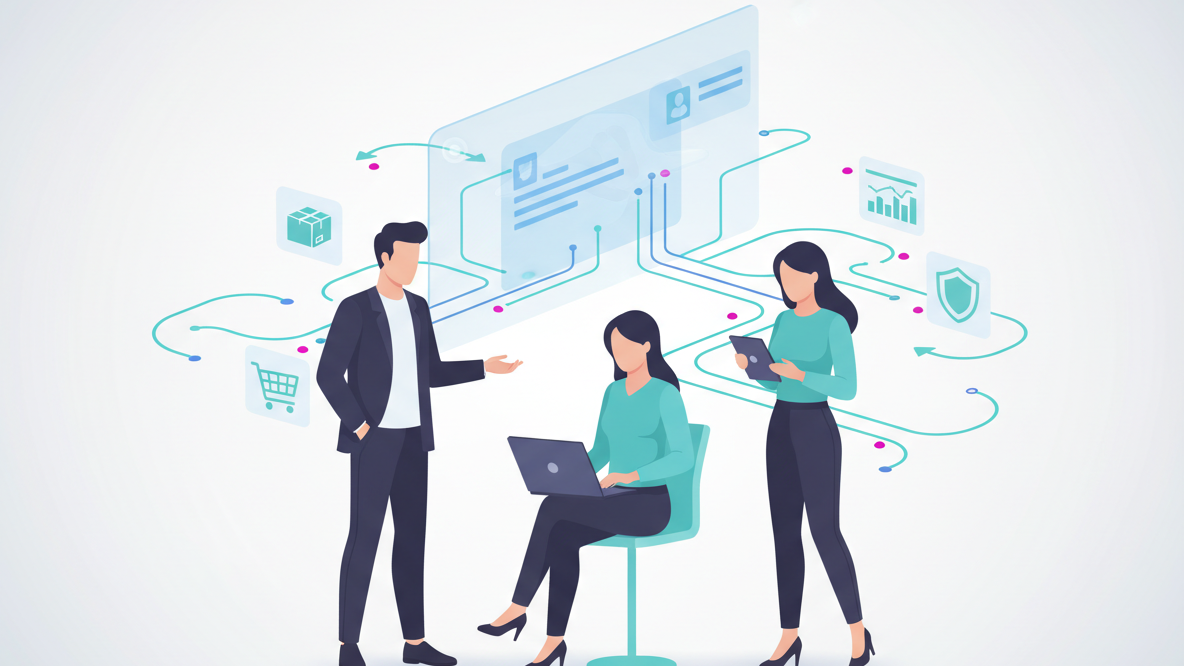
Unlike off-the-shelf tools that solve one slice of the workflow, end-to-end custom platforms connect front-of-house, back-of-house, finance, inventory, and guest engagement into a single operational fabric. The result isn’t “more automation.” It’s a new operating model: measurable, orchestrated, and scalable.
From disconnected workflows to one operating system
A modern restaurant runs like a real-time production line with customer experience as the output. Orders, preparation, timing, staffing, inventory, and payments all influence each other. When these functions live in separate tools (or worse, paper + WhatsApp + spreadsheets), teams compensate with manual coordination—repeating information, resolving misunderstandings, and firefighting.
Custom software replaces that human glue with system-level coordination.
A waiter taking an order on a handheld tablet is the simplest illustration: the order instantly appears on the kitchen display system, automatically categorized by station, cooking sequence, dietary constraints, table allocation, and priority. No manual relay. No transcription errors. No “Did you tell the kitchen?” moments.
But the deeper value is what happens next: the system updates preparation timelines, estimates serving schedules, and synchronizes front-of-house pacing so the entire service flow stays coherent.
The kitchen becomes a real-time execution environment
In high-volume hospitality, the kitchen is where time, quality, and margin collide. Custom software turns kitchen operations into a managed execution layer:
- Station-based routing: Grill, fryer, cold prep, pastry—each ticket is automatically routed and sequenced.
- Timing orchestration: Courses and items can be timed to land together, reducing rework and improving consistency.
- Dietary and allergen controls: Structured modifiers and flags reduce risk and improve compliance.
- Capacity-aware prioritization: Orders can be prioritized based on prep load and promised serving times.
This is not just convenience. It’s operational reliability—especially when the restaurant is busy, understaffed, or scaling to multiple locations.
POS is no longer “billing”—it’s financial infrastructure
At billing time, integrated POS workflows can support split payments, individual guest settlements, loyalty redemption, digital receipts, tax computation, and reconciliation across multiple payment gateways and counters.
Custom software matters here because every restaurant has edge cases:
- Different service styles (table service vs. counter service vs. hybrid)
- Complex discount rules and promotions
- Multiple revenue streams (dine-in, takeaway, delivery, catering)
- Multi-currency or multi-tax-region operations
When finance is stitched together from multiple tools, reconciliation becomes a daily drain. When it’s integrated, the data is clean by design—making reporting, audits, and cash control dramatically easier.
Inventory intelligence: where margins are won or lost
Restaurants don’t just sell food—they manage perishable supply chains under uncertainty. Inventory is one of the biggest levers for profitability, yet it’s often managed with manual counts and reactive ordering.
Custom software enables inventory intelligence through tight coupling with recipes and sales:
- Ingredient consumption is deducted automatically via recipe mapping when items are sold.
- Stock thresholds trigger procurement workflows before shortages become emergencies.
- Wastage becomes measurable (what was thrown away, when, and why).
- Vendor management becomes structured with pricing history, delivery performance, and quality tracking.
- Demand forecasting improves procurement precision by learning from historical patterns, seasonality, and events.
This is where “digital transformation” becomes tangible: fewer stockouts, less waste, better purchasing decisions, and a clearer view of true item-level profitability.
Reservation orchestration and table turnaround optimization
Reservations aren’t just bookings—they’re demand signals. When reservation systems are integrated with table management and kitchen capacity, restaurants can:
- Balance seating to avoid kitchen overload
- Improve table turnaround without harming guest experience
- Predict bottlenecks by time window (not just by day)
- Reduce no-shows with targeted confirmation flows
Custom platforms can also connect reservations to guest profiles, preferences, and spend history—turning a reservation into a personalized experience rather than a generic slot.
Workforce scheduling becomes operational strategy
Labor is one of the most expensive and volatile inputs in hospitality. Scheduling is often done by intuition, which works—until it doesn’t.
Custom software can connect staffing plans to:
- Forecasted covers and expected order volume
- Role-based capacity (how many cooks per station, how many servers per section)
- Faster completion of tasks
- Real-time adjustments (call-outs, spikes, late reservations)
- Compliance and audit logs (hours, breaks, overtime)
The goal isn’t to “optimize humans.” It’s to reduce chaos and protect service quality while controlling labor costs.
CRM-driven guest engagement: turning service into retention
In many restaurants, guest relationships are left to chance. Custom software can embed CRM into the operational flow:
- Guest profiles tied to reservations and POS
- Loyalty programs that reflect actual behavior (not just points)
- Targeted offers based on visit frequency, preferences, and spend
- Feedback loops that route issues to managers with context
This is how restaurants move from transactional dining to repeatable retention—especially important in competitive markets where acquisition costs keep rising.
Menu engineering and dynamic pricing: data becomes a decision engine
When orders, costs, and inventory are integrated, menu decisions stop being guesswork.
Custom analytics dashboards can show:
- Contribution margin per item (not just popularity)
- Prep-time impact and kitchen load per dish
- Waste correlation by ingredient and menu item
- Price elasticity signals by time window or channel
Some operators go further with dynamic pricing capabilities—adjusting prices based on demand, time, or inventory constraints. Done responsibly, this can protect margins without compromising brand trust.
Multi-location control: scaling without losing consistency
Scaling a restaurant brand is hard because consistency is hard. Custom software enables centralized multi-location operations control:
- Standardized recipes and prep workflows
- Unified inventory and vendor visibility
- Brand-level reporting with location drill-down
- Audit logs for operational compliance
- Rollout controls for menu changes and promotions
This is where end-to-end systems become a strategic asset: they let leadership run the business as a network, not as isolated units.
The real outcome: restaurants become data-driven ecosystems
The outcome of custom software is not merely automation. It is the transformation of restaurants into data-driven operational ecosystems that improve speed, consistency, margins, decision-making, and guest experience at scale.
When every operational event—an order, a substitution, a delayed ticket, a stockout, a refund—becomes structured data, restaurants gain a new superpower: the ability to see reality clearly and improve it continuously.
What to consider before building custom restaurant software
Custom software works best when it’s built with operational truth, not assumptions. A few practical principles:
- Start with the workflow, not the UI. Map service flow, kitchen flow, and exception handling.
- Design for edge cases. Allergens, split bills, comped items, voids, refunds, late reservations.
- Integrate deliberately. POS, payment gateways, delivery platforms, accounting, payroll—define what must be real-time vs. batch.
- Build observability in from day one. Audit logs, role-based access, and clear analytics.
- Roll out in phases. Pilot one location, one service period, one module—then expand.
Restaurants are no longer just hospitality venues. They are operational systems competing on speed, precision, and experience. Custom software is increasingly the layer that makes that competition winnable.