

Why “agent intelligence” is not the enterprise advantage
Enterprise AI conversations often start with model capability: reasoning, autonomy, tool use, and automation. But in real operating environments, intelligence alone rarely produces durable business outcomes. Enterprises don’t fail at AI because agents can’t answer questions; they fail because agents can’t reliably act inside the enterprise.
The differentiator is the orchestration layer—the control plane that governs how AI Agents and Agentic AI operate, collaborate, scale, and remain accountable. Orchestration is what turns “a smart agent” into a production-grade capacity engine.
This is where a full-stack custom software development company becomes strategically important. Full-stack teams are uniquely positioned to connect AI to the enterprise’s actual operating model: systems, data, workflows, governance, security, and performance constraints.
AI needs orchestration before it delivers capacity
Enterprises building capacity at scale to serve customers through products, solutions, and services don’t need isolated AI experiments. They need a structured framework that:
- Connects business processes to agent execution
- Integrates with existing systems of record and systems of work
- Enforces governance, security, and compliance requirements
- Creates measurable outcomes and feedback loops
- Supports multiple specialized agents without fragmentation
Without orchestration, agentic initiatives become disconnected automation islands: each agent solves a narrow task, but the organization can’t coordinate behavior across departments, channels, and customer journeys.
What the orchestration layer actually is: the enterprise control plane
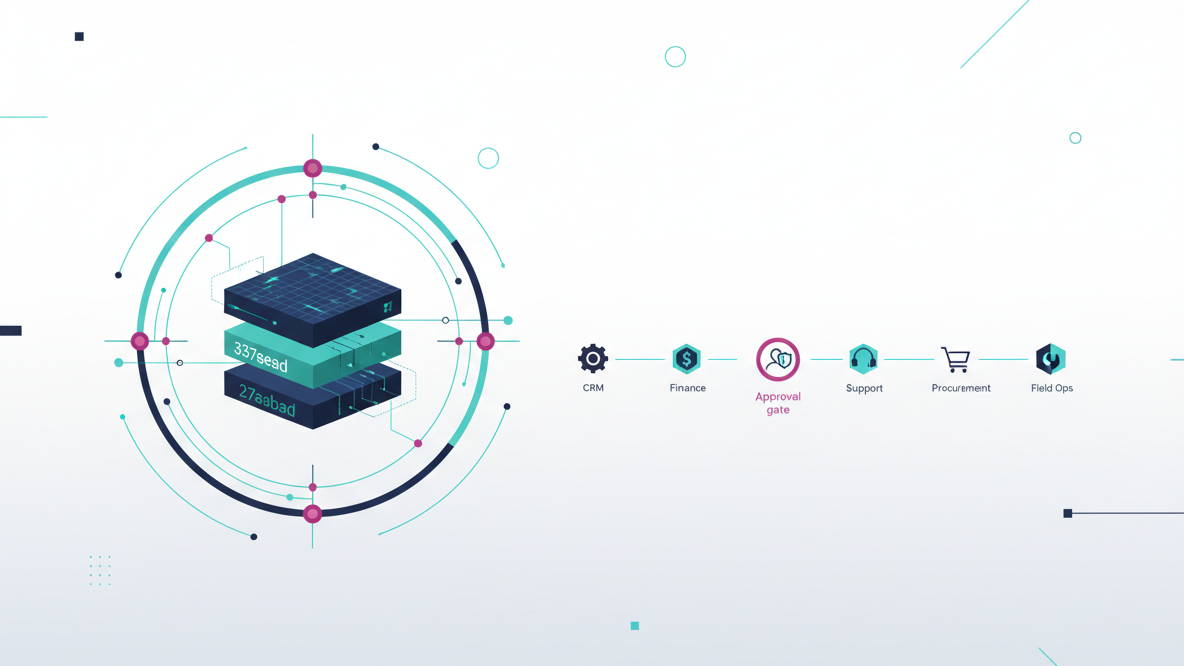
The orchestration layer is the enterprise control plane for agentic work. It determines how agents:
- Receive context and retrieve relevant knowledge
- Access enterprise data safely and appropriately
- Invoke business rules and policies
- Interact with applications and APIs
- Trigger workflows and coordinate with other agents
- Hand off to humans when needed
- Observe outcomes and improve over time
In practice, orchestration is not a single product. It is an engineered framework that spans architecture, integration, workflow, observability, and governance.
Why a full-stack custom software company is the right builder
A full-stack custom software partner can build the orchestration foundation because they already operate across the layers that orchestration demands:
- Application architecture: where agent capabilities are embedded into products and internal tools
- API design and integration: how agents reliably act on enterprise systems
- Workflow engineering: how decisions become execution across teams
- Security and access controls: how autonomy stays safe
- Data engineering: how context becomes accurate and timely
- Quality engineering and testing: how behavior becomes predictable
- Infrastructure and scalability: how agent fleets operate under load
Enterprises often have pieces of this puzzle, but the orchestration layer requires end-to-end cohesion. Full-stack teams specialize in building cohesive systems, not just prototypes.
Core components of an enterprise agent orchestration framework
1) Context and knowledge delivery
Agents are only as effective as the context they can access. Orchestration defines:
- What context is needed for each task
- Where it comes from (documents, CRM, ticketing, analytics, product telemetry)
- How it is retrieved (search, embeddings, structured queries)
- How it is filtered by permissions
- How it is refreshed and versioned
A full-stack team designs the retrieval strategy, builds the connectors, and ensures the context pipeline is consistent across agents.
2) Tooling and integration layer (the “hands” of the agents)
Enterprise value emerges when agents can do work: create tickets, update records, trigger deployments, generate quotes, schedule services, or resolve incidents.
Orchestration provides:
- Standardized tool interfaces and API wrappers
- Reliability patterns (retries, idempotency, circuit breakers)
- Transaction boundaries and rollback strategies
- Audit trails of every action
This is classic enterprise integration engineering—an area where full-stack custom teams excel.
3) Business rules and policy enforcement
Agentic AI becomes valuable only when orchestration converts intelligence into execution within constraints. Enterprises need:
- Policy engines (pricing rules, approval thresholds, compliance constraints)
- Guardrails (what can and cannot be changed)
- Domain-specific validation (data quality checks, contract constraints)
- Escalation rules (when to ask a human)
Full-stack teams can implement policy-as-code patterns so governance is explicit, testable, and version-controlled.
4) Workflow engines and human-in-the-loop coordination
Most enterprise work is not a single action; it is a chain of decisions and handoffs. Orchestration defines:
- Multi-step workflows (intake → triage → execution → QA → delivery)
- Agent collaboration (specialized agents coordinated by a supervisor pattern)
- Human checkpoints (approvals, exceptions, high-risk actions)
- Role-based task routing (who reviews what, when)
This is where agentic AI stops being “automation” and becomes an operating model.
5) Observability, evaluation, and continuous improvement
Enterprises need to know what agents did, why they did it, and whether it worked. Orchestration must include:
- Logging and tracing across agent actions and tool calls
- Metrics (cycle time, resolution rate, cost per outcome)
- Quality evaluation (accuracy, compliance, customer satisfaction impact)
- Feedback loops (human corrections, customer signals, downstream outcomes)
A full-stack partner can implement an observability stack that treats agent behavior like production software: measurable, debuggable, improvable.
6) Security, identity, and access controls
Agent autonomy without enterprise-grade security is a non-starter. Orchestration governs:
- Identity (service accounts, delegated access, impersonation rules)
- Authorization (RBAC/ABAC, least privilege)
- Data boundaries (tenant isolation, PII handling)
- Secrets management and key rotation
- Compliance logging and retention
Full-stack teams can align orchestration with existing IAM and security posture rather than bolting on controls later.
7) Scalability and multi-agent operations
Capacity building at scale means multiple agents operating concurrently across functions. Orchestration must support:
- Agent lifecycle management (deployment, versioning, rollback)
- Load management and prioritization
- Queueing and scheduling
- Cost controls (token budgets, tool usage constraints)
- Multi-region reliability and disaster recovery
This is infrastructure engineering plus product thinking—again, a natural fit for full-stack delivery.
From “AI experiments” to enterprise capacity building
When orchestration is done well, agentic AI becomes a capacity multiplier rather than a novelty.
Capacity outcomes enterprises actually care about
- Output increases without proportional headcount growth
- Response cycles compress (support, sales, operations, delivery)
- Service delivery becomes adaptive (dynamic routing, personalized resolution)
- Knowledge compounds (what one team learns becomes reusable across others)
- Products become more intelligent (embedded agent capabilities)
- Solutions become more responsive (real-time decisioning and execution)
The orchestration layer is what makes these outcomes repeatable and scalable.
How a full-stack partner approaches delivery: a practical roadmap
Phase 1: Map the operating model
- Identify high-volume, high-friction workflows
- Define outcome metrics (time saved, revenue impact, SLA improvements)
- Classify risk levels and governance requirements
Phase 2: Build the control plane foundation
- Standardize agent interfaces and tool contracts
- Implement context delivery and permissioning
- Establish observability and auditability
Phase 3: Deploy specialized agents as a coordinated fleet
- Start with 2–4 agents that cover an end-to-end workflow
- Add supervisor orchestration and human checkpoints
- Expand across functions using reusable patterns
Phase 4: Scale with governance and continuous improvement
- Add evaluation pipelines and feedback loops
- Optimize cost and performance
- Mature into a platform that internal teams can extend
The strategic conclusion
The next competitive edge may not belong to organizations with the most AI models. It may belong to organizations with the strongest orchestration frameworks—frameworks that allow thousands of decisions, interactions, and outcomes to move in synchronized motion across the enterprise.
A full-stack custom software development company can be the builder of that orchestration layer: the enterprise control plane that turns agent intelligence into execution, governance, and measurable capacity at scale.