

Traditional reporting was built for retention, compliance, and hindsight. It answers questions like what happened, who approved it, and how much did it cost. That’s useful—but it’s not cognition. As enterprises scale across distributed teams, fragmented SaaS stacks, and asynchronous communication, “reporting” becomes a lagging artifact of work rather than a living model of how work behaves.
Dashboards, even beautifully designed ones, often become captive to the same limitation: they visualize outputs from systems that were never designed to explain the reasoning, context, and causal chains behind those outputs. Leaders end up staring at charts that describe symptoms while the enterprise’s real dynamics—friction, risk, momentum, and intent—remain invisible.
Why dashboards plateau as organizations become more complex
Most enterprise dashboards are downstream of transactional systems. They inherit the structure of CRMs, ERPs, ticketing tools, and finance platforms—systems optimized to store records, not interpret behavior. That means dashboards tend to be:
- Schema-bound: limited to what the underlying tool chose to capture
- Batch-oriented: refreshed on schedules, not on reality
- Siloed: unable to correlate signals across tools without heavy manual work
- Outcome-focused: strong at “what,” weak at “why” and “what next”
In a smaller organization, humans bridge these gaps. Managers reconcile context in meetings, analysts consolidate spreadsheets, and teams explain anomalies through tribal knowledge.
At enterprise scale, that manual layer breaks. The organization’s behavior changes faster than humans can interpret it, and the cost of interpretation rises with every new tool, workflow, and geography.
The shift from reporting to operational cognition
Enterprises don’t just need visibility. They need cognitive intelligence: systems that continuously observe operational behavior, detect patterns, infer causality, and surface actionable narratives.
This is where custom software becomes strategically important—not as “another dashboard,” but as the intelligence layer that turns operational exhaust into real-time inference.
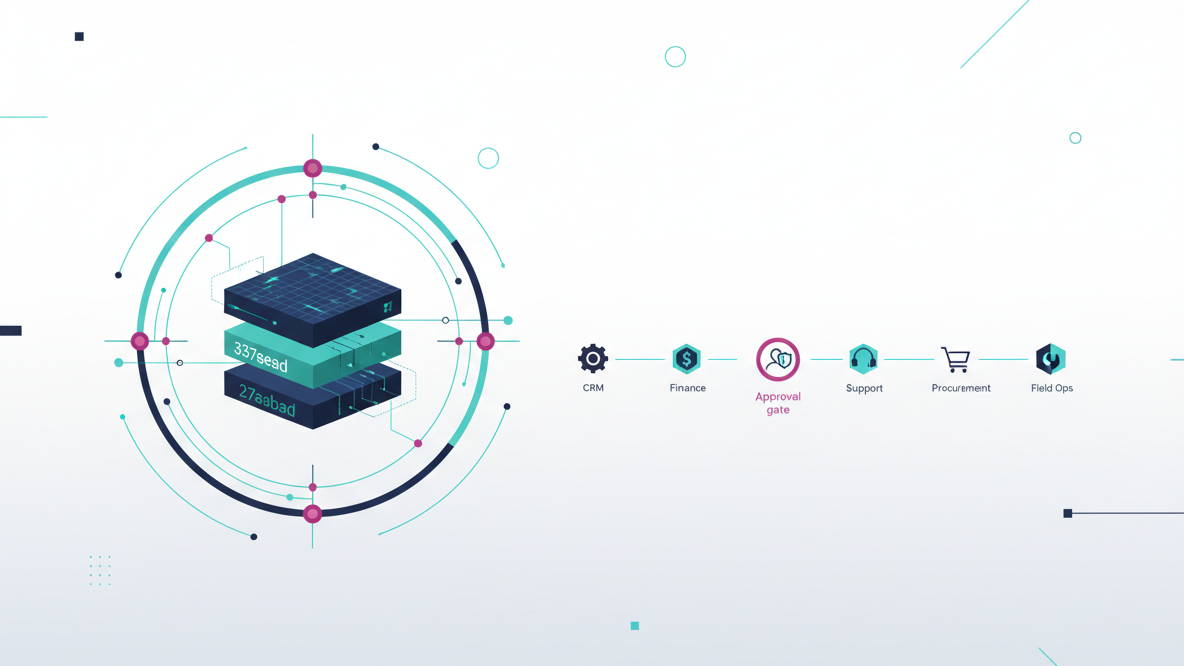
Instead of waiting for someone to export spreadsheets, reconcile metrics, and explain what changed, a cognitive layer continuously ingests signals from:
- APIs across SaaS platforms
- ERP and finance systems
- CRM and pipeline activity
- Workflow engines and approvals
- IoT and operational streams
- Support interactions and customer sentiment
- Transactional databases and event logs
But the real enterprise value sits underneath:
- Process orchestration: how work moves across teams and systems
- Data models: what the business considers “true” and how entities relate
- Decision logic: how policies, pricing, risk, and approvals are executed
- Auditability and governance: what happened, why, and who approved it
With event-driven architectures, every workflow mutation becomes observable telemetry. The enterprise stops being a set of disconnected tools and becomes a measurable system.
What “cognitive dashboards” actually do differently
A cognitive dashboard isn’t defined by better charts. It’s defined by better interpretation. It behaves more like an inference surface than a reporting page.
1) It detects friction gradients, not just delays
A traditional dashboard might show that approvals are taking longer.
A cognitive system can identify where friction is forming, correlate it with workload, dependencies, policy changes, or staffing shifts, and quantify the operational drag before it becomes a visible failure.
2) It correlates operational signals across domains
When procurement cycles accelerate, a cognitive layer can connect that acceleration to inventory volatility, supplier performance history, fulfillment behavior, and downstream customer impact.
This is hard to do with off-the-shelf tooling because the causal chain crosses multiple systems with different schemas and timestamps.
3) It surfaces risk before it hits financial statements
Churn rarely begins as a revenue event. It begins as a behavioral pattern: escalation language in support tickets, reduced product usage, delayed renewals, stakeholder changes, or sentiment shifts.
Semantic parsers and retrieval-based architectures can identify these patterns early, turning “customer health” from a lagging score into a leading indicator.
4) It turns metrics into narratives executives can act on
Executives don’t need more charts—they need operational narratives:
- What changed?
- Why did it change?
- What will happen if it continues?
- Where should we intervene?
Cognitive dashboards can present dependency maps, anomaly explanations, probabilistic forecasts, and recommended actions—grounded in real telemetry.
The modern stack behind enterprise inference systems
To move from visualization to cognition, enterprises increasingly rely on custom software stacks that combine:
- Stream processing for real-time ingestion and transformation
- Distributed caching for low-latency intelligence surfaces
- Semantic indexing to make unstructured signals searchable and comparable
- Graph databases to model dependencies between entities and workflows
- Retrieval architectures to ground insights in traceable operational evidence
- Predictive modeling pipelines for forecasting and scenario analysis
The goal isn’t “AI for dashboards.” The goal is ambient intelligence: a system that continuously thinks alongside operations.
Why custom software matters (and off-the-shelf hits a ceiling)
Off-the-shelf platforms force enterprises to adapt their reporting to predefined schemas and assumptions. That’s acceptable when the business can conform to the tool.
But enterprises with unique operational topology, decision velocity requirements, escalation logic, and cross-functional dependencies need the inverse: reporting architecture engineered around how the organization actually behaves.
Custom software enables:
- Instrumentation that matches real workflows (not generic templates)
- Correlation across tools without manual reconciliation
- Domain-specific intelligence models (risk, bottlenecks, leakage, forecasting)
- Proactive alerts and recommendations embedded into the flow of work
Most importantly, it removes dependency on manually generated reports. Intelligence becomes infrastructure.
The real transformation: from recording outcomes to reconstructing causality
Traditional systems record outcomes.
Cognitive intelligence reconstructs the causal chain that produced them.
That shift changes how enterprises operate:
- Teams stop reacting to lagging indicators
- Leaders gain earlier, clearer intervention points
- Operations become measurable, explainable, and optimizable
- Decision-making accelerates without sacrificing context
Dashboards aren’t going away. But the winners won’t be the organizations with the prettiest charts.
They’ll be the ones whose dashboards are backed by systems that can observe behavior, infer meaning, and recommend action—in real time.
Captive dashboards aren’t enough. Enterprises need cognitive intelligence.