

The Enterprise Reality: Many Systems, One Business
Modern enterprises no longer run inside a single application boundary. Operations flow through CRMs, ERPs, payment gateways, logistics platforms, analytics tools, mobile apps, cloud databases, and third-party APIs. Each system captures a slice of reality, at a different time, with different identifiers, schemas, and failure modes.
In this environment, “data processing” is not the hard part anymore. The hard part is ensuring that every system reflects the same operational truth, consistently, even as integrations change, teams ship new features, vendors update APIs, and volumes scale.
That is why reconciliation has moved from a back-office activity to a strategic engineering capability.
What Reconciliation Actually Means in Software Terms
Software reconciliation is the continuous process of comparing, validating, and synchronising data across systems, databases, services, and application states so the enterprise can trust its own operations.
In practice, reconciliation answers questions that are deceptively simple but operationally critical: Did the payment that succeeded in the gateway create the right invoice in the ERP? Did the shipment that left the warehouse update the customer’s order status everywhere it should? Did the refund propagate to accounting, customer communications, and reporting? Are the numbers in dashboards derived from the same underlying truth as the ledgers and operational systems?
Reconciliation is not only about matching records. It is about verifying state transitions across distributed workflows, and proving that what the business believes happened is what the systems actually recorded.
Why Mismatches Happen (Even in “Good” Architectures)
State divergence is not a sign of incompetence; it is a natural outcome of distributed systems and organisational scale. Enterprises integrate systems that were never designed to share a single source of truth. They rely on asynchronous messaging, retries, eventual consistency, and third-party services outside their control.
A webhook arrives late. A queue message is processed twice. A vendor API rate-limits during peak load. A schema changes subtly. A network partition causes a timeout after a payment is authorised but before the internal order is updated. A human corrects a record in one system but not another. None of these events are exotic; they are routine.
Without engineered reconciliation, these routine events accumulate into silent operational debt.
The Cost of Treating Reconciliation as an Afterthought
When reconciliation is manual or bolted on, the organisation pays in ways that are easy to underestimate. Teams lose time validating what should be true. Reporting becomes a negotiation rather than a reference. Finance and operations build parallel spreadsheets to “fix” system outputs. Customer support absorbs the impact when customers see one status while internal tools show another.
Over time, the enterprise develops a dangerous habit: trusting people to correct what systems fail to guarantee. The deeper cost is not just time. It is the erosion of confidence. Once leaders and teams stop trusting the numbers, every decision slows down.
Custom Software as the Reconciliation Advantage
Off-the-shelf workflows can move data, but they rarely provide enterprise-grade verification. They are typically designed for integration, not for truth maintenance. Custom software changes the game because it allows reconciliation to be engineered into the operational architecture itself.
A custom reconciliation layer can be designed around the organisation’s real process semantics: what “complete” means for an order, what “settled” means for a payment, what “delivered” means for a shipment, and what “closed” means for a case. Those definitions are business-specific, and they evolve.
By building reconciliation as software, organisations can shift from reactive checking to proactive control.
From Checks to Control: Reconciliation as a Verification Engine
At scale, reconciliation becomes a continuous verification engine that runs alongside the business, not behind it. Instead of waiting for month-end or incident-driven investigations, the enterprise verifies operational truth as events flow through systems.
This is where reconciliation becomes an enterprise control layer: a system that continuously compares expected states with observed states, detects divergence, and orchestrates corrective workflows. In other words, reconciliation becomes the mechanism that turns distributed operations into a coherent, governable machine.
What an Intelligent Reconciliation Layer Does
A modern reconciliation capability is not a single script or a nightly job. It is a set of engineering primitives that can be applied across domains: finance, logistics, customer operations, product analytics, and compliance.
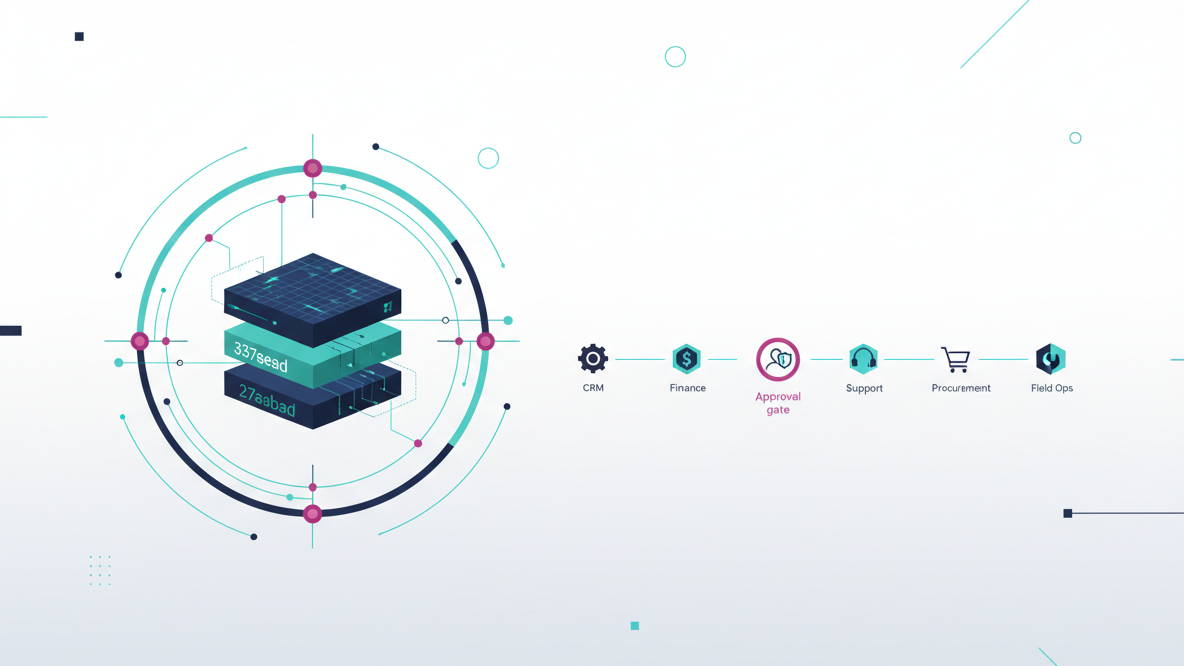
It can compare transactional states across distributed systems, detect anomalies in near real time, validate data consistency across APIs and integration layers, and track event lineage across processing pipelines. It can automate exception handling, maintain audit trails, and synchronise multi-source records with precision.
Crucially, it can do this while acknowledging that systems fail—and designing for that reality.
Core Capabilities to Engineer
- Canonical identifiers and mapping: A reliable way to correlate the same business entity across systems, even when each system uses different IDs.
- State models and invariants: Explicit definitions of allowed state transitions and what must be true when a state changes.
- Event lineage and traceability: End-to-end correlation from trigger to downstream effects, including retries, compensations, and manual interventions.
- Real-time mismatch detection: Rules and statistical signals that surface divergence quickly, not weeks later.
- Exception workflows: Automated routing, enrichment, and resolution paths so mismatches become manageable work items.
- Auditability by design: Immutable logs, evidence trails, and explainability for compliance and internal governance.
- Precision synchronisation: Controlled updates that fix drift without creating new inconsistencies.
Scaling Reality: Integration Touchpoints Grow Exponentially
As enterprises scale, integration touchpoints multiply. Every workflow engine, middleware layer, cloud service, and external platform introduces new opportunities for divergence. The complexity is not linear; it compounds.
This is why reconciliation cannot remain a periodic task. It must become continuous, systematic, and engineered. When reconciliation is built as a core capability, the organisation gains resilience. Failures still happen, but they are detected, contained, explained, and corrected with far less operational disruption.
Reconciliation Beyond Finance: The Foundation of Trustworthy Automation
Historically, reconciliation was framed as a finance function: matching payments, invoices, and settlements. That is still essential, but the scope has expanded.
Today, reconciliation is foundational to reliable automation. If systems cannot agree on truth, automation amplifies errors faster than humans can correct them. Conversely, when reconciliation is embedded, automation becomes safer: workflows can proceed with confidence, because verification is continuous.
This also transforms analytics. Trustworthy dashboards are not produced by better visualisation; they are produced by better truth maintenance upstream.
Building It In-House: Why the “All Under One Roof” Model Matters
Engineering reconciliation requires cross-disciplinary execution: domain understanding, integration engineering, data modelling, QA, and operational observability. It also requires iteration, because business definitions evolve and integrations change.
At Deventure.co, we approach reconciliation as part of resilient digital infrastructure. With UI/UX, custom software development, and quality assurance delivered in-house, reconciliation can be designed as a product capability rather than a patchwork of scripts and manual checks. The goal is speed to market without sacrificing correctness—because in distributed enterprises, correctness is what keeps speed sustainable.
The Strategic Takeaway
Reconciliation is no longer a background activity. It is a control layer that protects operational integrity across a fragmented software ecosystem.
Enterprises that engineer reconciliation into the fabric of their systems gain something rare: the ability to scale complexity without losing trust. They reduce silent drift, prevent mismatches from becoming incidents, and build a foundation for automation, compliance, and decision-making that remains reliable as the organisation grows.
Deventure.co believes the organisations building resilient digital infrastructure tomorrow will be the ones engineering reconciliation into the core fabric of their software ecosystems today.