

Why “intelligence” isn’t the same as “outcomes”
AI agents and modern LLM stacks are advancing fast. We can now build systems that reason, plan, coordinate tasks, and generate high-quality outputs in seconds. Retrieval Augmented Generation (RAG) adds another leap forward by grounding responses in enterprise knowledge, reducing hallucinations and improving relevance.
But in real organisations, outcomes don’t emerge from intelligence alone. Outcomes emerge when intelligence is connected to operational context: the workflows, constraints, approvals, data structures, and governance that define how work actually gets done.
This is the gap many enterprises hit after the initial excitement. They can produce impressive demos, but struggle to translate them into reliable, repeatable business impact.
The missing layer: enterprise reality
AI agents can propose actions. RAG can supply information. Yet neither inherently understands:
- How your teams route decisions (who approves what, when, and why)
- Which actions are allowed under compliance, security, and audit requirements
- The difference between “possible” and “permitted” in your environment
- The business rules that live in people’s heads, spreadsheets, and legacy systems
- The operational edge cases that make enterprise work messy and non-linear
Enterprises are not blank canvases. They are living systems with history, constraints, and accountability.
Custom software as the interface and orchestration layer
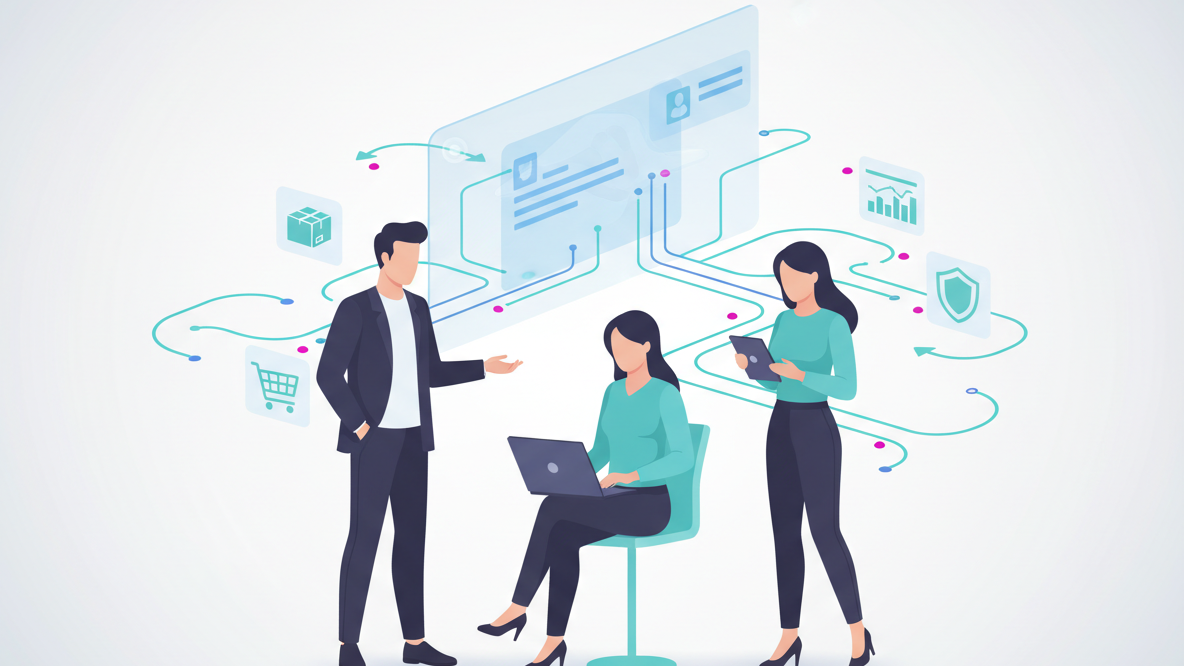
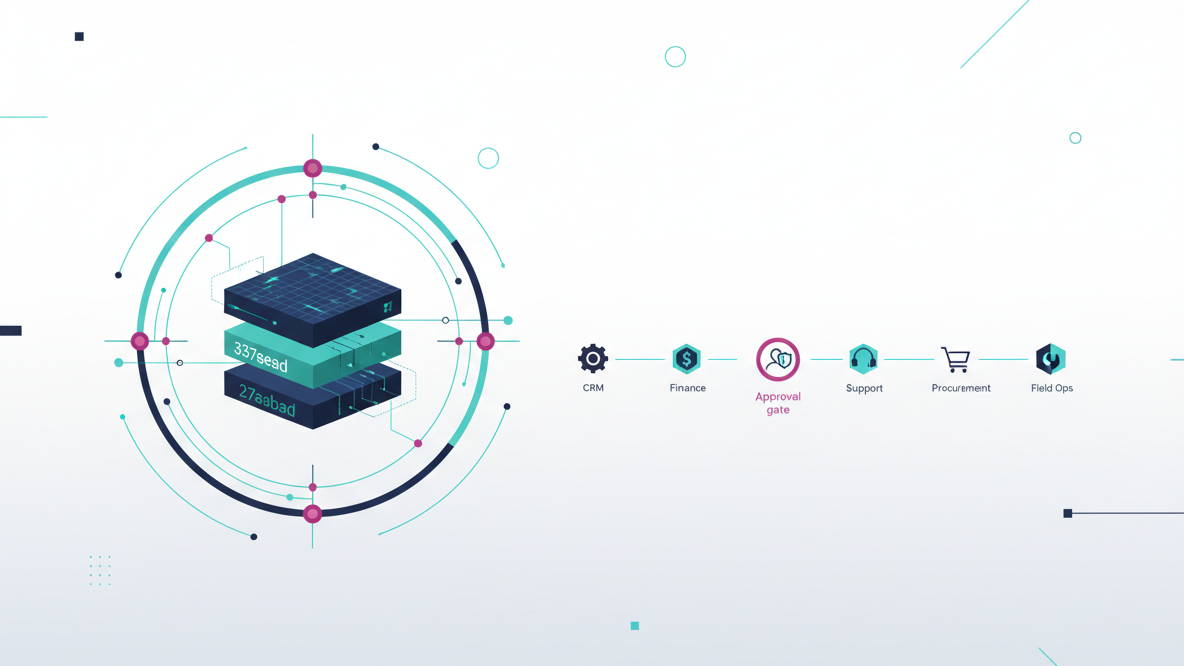
Custom software becomes the strategic layer that connects AI capabilities to enterprise reality. It is the interface layer that:
- Orchestrates how agents interact with internal systems
- Encodes decision boundaries and approval chains
- Applies governance, security, and traceability
- Translates business rules into executable logic
- Determines what information from RAG pipelines is trusted and actionable
In practice, this layer is what turns an agent from “a smart assistant” into “a reliable operator inside the business.”
What this layer actually does (in concrete terms)
1) System access and tool orchestration
Agents don’t “use your systems” by default. They need controlled connectors and tool interfaces.
Custom software defines:
- Which systems are accessible (CRM, ERP, ticketing, finance, HR, data warehouse)
- What operations are allowed (read-only vs write, create vs approve vs delete)
- Rate limits, escalation rules, and safe fallbacks
- How to handle partial failures and retries
This is where reliability starts.
2) Decision boundaries and human-in-the-loop controls
Enterprises need accountability. Not everything should be automated.
Custom software sets boundaries such as:
- “Agent can draft, human must approve”
- “Agent can execute only under threshold conditions”
- “Agent can recommend, but cannot commit spend”
- “Agent can act only if confidence and source quality meet policy”
This is how you prevent automation from becoming operational risk.
3) Governance: permissions, logging, and auditability
In enterprise contexts, it’s not enough to be correct. You must be provable.
The orchestration layer should implement:
- Role-based access control aligned with organisational permissions
- Full event logs: what was retrieved, what was decided, what was executed
- Traceability from output back to sources and policies
- Data handling rules (PII, retention, encryption, redaction)
This is what makes AI systems deployable in regulated environments.
4) Business rules translated into executable logic
LLMs are great at language. Enterprises run on rules.
Custom software encodes:
- Pricing logic, eligibility rules, SLAs, and escalation paths
- Domain-specific validations and constraints
- Workflow steps and state transitions
- “If X then Y” logic that must be consistent every time
This is the difference between a persuasive answer and a correct action.
5) Trust and actionability in RAG pipelines
RAG is powerful, but retrieval is not the same as truth.
Custom software determines:
- Which sources are authoritative (policy docs vs outdated wiki pages)
- Recency requirements (what counts as “current”)
- Conflict resolution (what happens when sources disagree)
- Source quality scoring and filtering
- Citation requirements for high-impact actions
This is how you get grounded outputs that are also operationally safe.
The outcome: grounded execution, not just grounded text
When custom software provides the interface layer, enterprises can achieve:
- Context-aware execution across real workflows
- Controlled interaction between agents and internal knowledge systems
- Outputs aligned to objectives, governance, and constraints
- Continuous feedback loops that improve decisions over time
- Scalable capacity building without increasing operational complexity
In other words: the organisation gains leverage without losing control.
A practical mental model
Think of the stack like this:
- LLMs generate reasoning and language
- RAG supplies relevant enterprise context
- AI agents plan and coordinate tasks
- Custom software enforces how all of the above interacts with the real business
Custom software is where enterprise-grade AI becomes measurable.
What to build first (a sensible starting point)
If you’re moving from prototype to production, start with the orchestration foundations:
- Define the workflows you want to augment (not “use AI everywhere”)
- Identify decision points and approval requirements
- Implement tool interfaces with least-privilege permissions
- Add logging, traceability, and audit trails from day one
- Establish RAG source governance (authoritative sources, recency, conflict rules)
- Create feedback loops (outcome tracking, user corrections, policy updates)
This approach keeps momentum while avoiding the most common enterprise AI failure mode: impressive outputs with fragile operations.
Closing: intelligence creates possibilities, custom software creates outcomes
The future isn’t AI replacing enterprise systems.
The future is custom software becoming the orchestration and interface layer that allows AI agents and RAG architectures to operate with precision, accountability, and measurable business impact.
Intelligence creates possibilities. Custom software turns those possibilities into enterprise outcomes.